Friday, January 31
Flashback Friday
To humor myself, I thought I'd start a habit of weekly cyber-documenting the parallel political and economic universes we appear to share with the first Bush administration. The following are from various papers around the US on this date in 1991, midway through his first (and only) presidential term. Its also easier to click, cut and paste than write text when holding a sick, sleeping baby.
COULD THE 'R' IN THE ECONOMY REALLY BE A 'D'?
January 31, 1991, Robert Lenzner, Boston Globe Staff
NEW YORK -- The "D" word. Hardly anyone in Wall Street dares use it. It conjures up images of the 1930s -- soup kitchens, 25 percent unemployment, bank closings.
No one is predicting the calamity that drove the Dow Jones industrial average down 90 percent from October 1929 to March 1932. But, the concept of depression is being considered a possibility by some respected economists.
VA. JOBLESS RATE UP TO 4.9 PERCENT: LEVEL AT 4-YEAR HIGH, STATE SAYS
Anne Swardson, Washington Post
January 31, 1991
Virginia's unemployment rate reached its highest level in four years last month, rising to 4.9 percent, the Virginia Employment Commission announced yesterday.The news was particularly unpleasant in Northern Virginia, which the report showed has lost 12,400 jobs in the last 12 months. By contrast, the state as a whole still is gaining jobs.The figures provide a prelude to the December unemployment statistics for the entire Washington metropolitan area scheduled to be released ...
State Budget-Cutters Look at Welfare
Chicago Tribune, January 31, 1991
As the political infighting begins over whose budget will be cut to meet Gov. Jim Edgar's austerity demands, state officials are considering the reduction or elimination of monthly General Assistance payments of $165 each to an estimated 80,000 single, unemployed people in Chicago.
The General Assistance program, which was budgeted this year at approximately $180 million, has come under cost-cutting consideration because state budget ...
EDUCATION GROUP PROPOSES TESTING
January 31, 1991, Associated Press
WASHINGTON -- A new education advocacy group proposed yesterday that Congress require public and private high schools to administer a standard achievement test to all seniors. Educate America -- a nonprofit, nonpartisan group headed by former New Jersey Gov. Thomas Kean -- proposed the nationwide exam because current achievement measures do not adequately establish schools' progress toward meeting the education goals established by President Bush...
THE DOMESTIC AGENDA
Washington Post
January 31, 1991
THE DOMESTIC sections of the State of the Union address were aimed as much at deflecting action as at encouraging it. The president paid lip service to the agendas of both right and left -- everything from empowerment to infrastructure and a national energy policy -- but committed himself to very little. In part that is a reflection of circumstance, but in part it bespeaks temperament and choice as well. The country is both at war and in a recession...
Greenspan Ties Recession to Length of War
The Los Angeles Times
January 31, 1991
Alan Greenspan told the New York Times in an interview conducted before President Bush's State of the Union address Tuesday that he expected a quick recovery from the current recession if the war is "relatively short" and if the oil fields in the Gulf do not suffer serious damage.
DORMANT WEAPON WAITING, PREPARING FOR IRAQI TERRORISM
January 31, 1991, Jonathan Kaufman, Boston Globe Staff
BERLIN -- Saddam Hussein is doing what he said he would do: launch missiles at Israel, use oil as a weapon, engage the United States in land battle. Which is why experts are becoming increasingly nervous about one of the still-unused weapons in Iraq's arsenal -- terrorism.
Signs of a `short, mild' recession
Chicago Tribune
January 31, 1991, Marianne Taylor
The government's chief economic forecasting gauge crept up 0.1 percent in December, reversing its trend of previous months and leading analysts to conclude the recession may be short-lived.
"The suggestion from this report is that it is looking more and more like a short, mild recession, a relatively modest contraction," said James Annable, economist for First National Bank of Chicago...
Hmmm...In 12 years, will North Korea be our ally in the "War on Terror"?
PAKISTAN CONDEMNS AID CUT
From News Services, Washington Post
January 31, 1991
Pakistan's top nuclear official berated the United States for an aid cutoff and said Islamabad would never give up its controversial atomic development program.Atomic Energy Commission Chairman Munir Ahmed Khan also said in a speech in Lahore that Pakistan would not accept unilateral nuclear restrictions. The United States suspended $564 million in aid Oct.
And finally...so it was Poppy who invented it...
DATA NETWORK FUNDING MAY BE FIRST STEP TOWARD U.S. 'TECHNOLOGY POLICY'
Evelyn Richards, Washington Post
January 31, 1991
The White House appeared to signal this week that the administration will provide funding in its new budget for initial development of a nationwide data network that would connect thousands of universities and companies throughout the country on a sort of superhighway for information. As envisioned, the network would allow information to be exchanged at the rate of 50,000 single-spaced typed pages a second -- at least 1,000 times faster than all but a few of the data networks in use...
posted by MB
|
link |
9:44 AM |
Thursday, January 30
As Goes Maine, Redux
As I posted way back here, Maine is currently the state closest to implementing a universal coverage, single-payer health plan (which passed the State House and was hung up in the Senate by one vote - the Democrats now control both houses and as well as Blaine House, the governor's manse.) Today, a long awaited study was released which could now pave the way for the reintroduction and passage of LD1277.
Panel: Single-payer plan could save
by Tom Bell, Portland Press Herald Writer
Thursday, January 30, 2003
AUGUSTA — A single-payer health care system could provide coverage to everyone in Maine while saving residents and businesses money, according to a preliminary report to be released today by a legislative panel.
The Health Care System and Health Security Board's report is expected to stop short of endorsing the single-payer approach. The board, however, has concluded that the current health care system cannot be sustained because of soaring costs.
What is most remarkable about the study is that it was unanimously approved by the 19-member board, which included representatives of business groups, hospitals, insurers, labor unions and both major political parties in the Legislature.
"This is a tremendous achievement," said Paul Volenik, a former state representative who developed the single-payer proposal and co-chairs the board along with Sen. John Martin, D-Eagle Lake. "Now we have to sell this to the Legislature and the governor."
While Gov. John Baldacci looks for ways to incrementally reform the health care system, efforts to overhaul the system completely should continue, said Dr. Richard Wexler, the physicians' representative on the board. He said major reform, such as a single-payer plan, offers the best chance of providing universal coverage at the lowest cost, and Baldacci should keep the option open.
"There has been a lot of work done on this plan," said Wexler, who spoke about the report Wednesday at a legislative policy forum at the Augusta Civic Center. "It's important not to drop the ball."
Baldacci's spokesman, Lee Umphrey, said the study is important, and that the administration will consider it as it moves forward on health care reform.
Bill Cohen, spokesman for Anthem Blue Cross and Blue Shield, said insurers would rather see the current system fixed and made sustainable. The governor's idea of incremental reform is also more realistic, he said. A single-payer system, he said, would require the federal government to change its policies in the way it allocates Medicare and Medicaid funds, and there is little chance of that happening anytime soon.
"The governor's office is dealing with things with a sense of reality," Cohen said. "At least he's focusing on how to fix what's here and not create this new bureaucracy."
Cohen said Anthem has hired a consultant to examine the report's analysis, which was done by Mathematica Policy Research, a national health policy research group.
Mathematica concluded that total health care spending in the state will jump to nearly $8.4 billion by 2004, a 37 percent increase over 2000. Mathematica found that a single-payer system could provide savings of nearly $1 billion by 2008.
A single-payer plan would provide health coverage to all Maine residents through one standard benefit plan that would be administered and paid for by the state or by a private group under contract with the state. Businesses and residents would no longer pay health insurance premiums. Rather, employers would pay a payroll tax, with their employees paying a share of that tax. Residents also would have co-payments for medical care and drugs. When people lose their jobs, they would keep their health coverage.
The most practical benefit plan, according to the report, would require $50-per-day co-payments for hospital visits, cap families' out-of-pocket expenses at $2,000 annually, and provide free preventive care.
The state also could negotiate with drug companies for lower prices, as is done in Canada, Volenik said.
He said a single-payer plan would reap huge savings by slashing administration costs and eliminating insurance profits. In addition, doctors and hospitals also would see administrative costs go down because they would no longer have to keep as many workers to file and appeal insurance claims.
Small businesses, which typically pay 20 percent to 30 percent of their payroll for health insurance premiums, would stand to benefit the most under a single-payer plan because they would pay less in new taxes than they pay for insurance premiums, Volenik said. Large companies, which are able to get better prices from insurance companies, would also see costs go down, but not as dramatically, he said.
The Legislature created the Health Security Board in 2001 to assess the feasibility of providing a single-payer health care system in Maine. The board now wants the Legislature to allow it to continue to work on the issue for another year. Volenik said the board needs to create a more detailed plan for what the system would look like and how it would be put together and administered. It will make its request at a public hearing next Monday at a meeting of the Legislature's Banking and Insurance Committee.
HEALTH SECURITY BOARD MEMBERS
Here is a list of Health Security Board members and their affiliations:
Appointed by the Senate president:
Sen. John L. Martin, D-Eagle Lake, chairman
Mary E. Small, former Republican senator from Bath
Robert Downs, representing health insurers
Tammy Greaton, universal health-care advocate
Marjorie Medd, children's advocate
Dr. Leo Siegel, representing small hospitals
Dr. Richard Wexler, representing physicians
Appointed by the speaker of the House:
Paul Volenik, former Democratic representative from Brooklin
Rep. Florence T. Young, R-Limestone
James Amaral, owner, Borealis Breads, representing the business community
Howard Buckley, former president, Mercy Hospital, representing large hospitals
John Moran, advocate for senior citizens
Frank O'Hara, representing self-employed people
Patricia Philbrook, representing statewide organization of nurses
Violet Raymond, labor representative, Maine AFL-CIO
Other appointments:
Frank A. Johnson, director, state Office of Employee Health and Benefits
Anthony Neves, state tax assessor
Christine Zukas-Lessard, deputy director, state Bureau of Medical Services, representing the DHS commissioner
posted by MB
|
link |
6:46 PM |
Today's Economics Quiz, Part I
What does this:
Natural Gas Prices Up as Mercury Falls
and this:
Crude climbs on war fears
Have to do with this?
Dow Chemical Posts Loss; Cuts 4,000 Jobs
According to Reuters,
NEW YORK (Reuters) - Dow Chemical Co. , the No. 1 U.S. chemical maker, said on Thursday it would eliminate up to 4,000 jobs this year as high energy costs and an asbestos charge widened its fourth-quarter loss.
The high cost of crude oil and natural gas wiped out a 9 percent rise in revenue. That, combined with weak U.S. industrial demand, pushed Dow to pare 8 percent of its work force and cut capital spending by $400 million for 2003.
Shouldn't the Administration have forecast such a scenario, thus moderating its rosy projections for a robust recovery?
From the DOE's Winter Fuels Outlook, 2002-2003, the predicted trend for natural gas prices:
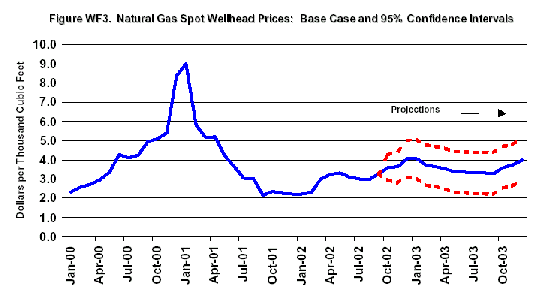
While here is the actual trend in natural gas futures:

Stay tuned for Part II, or "What does this mean for consumers?"
posted by MB
|
link |
3:42 PM |
A small victory and a big check
Two pieces of mascot-related news; first, from UPI (via email from Jenny),
SKINS NO MORE
By Ellen Beck
Published 1/30/2003 4:30 AM
The Lincoln, Neb., Journal-Star newspaper will no longer call the pro football team in the nation's capital city the Washington Redskins -- it will just be Washington.
Editor Kathleen Rutledge also tells readers the newspaper will stop printing logos for professional and college sports teams that use American Indian symbols -- "ones that adopt imagery such as an arrowhead and ones that caricature Native culture." Instead the paper will use alternative logos that stay away from such symbols.
Another change is the paper will drop the stereotypical modifier "Fighting" when used with team nicknames, such as Fighting Sioux or 2Fighting Illini.
"We've made this decision out of respect for Native people. Plain and simple," Rutledge writes to readers.
In an op-ed on the Journal-Star's announcement, Seattle Post-Intelligencer columnist John Levesque mused,
"The journalist in me is inclined to agree. We're supposed to be dispassionate, fair and careful not to distort the truth. If there's a team out there called the Redskins, our readers ought to be aware of it, no?
But my inner citizen, who clearly has seen too many Keith Jackson telecasts, is thinking, "Whoa, Nellie! If the Pekin Chinks were still around today, would we use the team nickname in the paper?"
I don't think so.
Pekin, a town in central Illinois not far from Peoria, is thought to be named for the Chinese capital. Its high school teams were the Chinks until 1981, when public sentiment forced a change to Dragons."
Read his whole column for more background and a journalists perspective on the controversy.
And second, a group of kids to be held as role models for all (via the Casper Star-Tribune);
Fightin' Whites present $100,000 check for UNC scholarships
GREELEY, Colo. (AP) - A college intramural basketball team that used satire to fight what it saw as racism has given a $100,000 check to the University of Northern Colorado for minority scholarships.
The basketball players, many of them American Indians, called themselves the ''Fightin' Whites'' as a slap at an area high school whose team nickname is the ''Fighting Reds.''
After getting national media attention, the team sold at least 15,000 of its T-shirts, with its name and slogan ''Everything's going to be all white.''
Proceeds from the Internet sales will establish the Fighting Whites Minority Scholarship for Native American students at the University of Northern Colorado.
The team also has designated money for Hispanic, African-American and Asian students. Team members presented the check to UNC Wednesday.
''It shows what creativity and humor can do to motivate people to do good things,'' UNC President Kay Norton said. ''You can sometimes create a discussion about uncomfortable topics by using humor in the right way.''
Members of the Fightin' Whites, who will play their first game of the season Feb. 8, said they are proud their campaign against stereotypical mascots has taken a new turn.
''We made history. Now this is the giving back part of our culture,'' said Solomon Little Owl, a team member and director of Native American Student Services at UNC.
The team started its campaign last winter after Eaton High School rejected a request by some UNC students to change its mascot from the ''Fighting Reds.''
You can help fund future scholarships by visiting the Fighting Whites website.
posted by MB
|
link |
7:59 AM |
Lies, damn lies and statistics
I think Mark Twain said that - or was it Disraeli?
I really can't blog much today, as my 6-month old Keziah (aka Kezzie or Kez in a pinch) is sick with the plague which has been moving through our household. My eldest has had it for almost 2 weeks, and I thought that since Kez in exclusively breastfed, we might have dodged that bullet. No such chance. However, even as wonderful Emma was running the numbers for Bush Deux's (Duh?) SOTU speech, I was doing the same for Bush I and II. I warned you I'm perserverating on these two.
Here are few others:
Word Count
| 1991 | 2003
| Total
| 3829
| 5400
| Saddam
| 6
| 19
| AIDS
| 1
| 12
| Education
| 3
| 2
| Nuclear/Nukular
| 0
| 12
| Freedom
| 15
| 5
| Tax cut/relief/reduction
| 3
| 10
| Jobs
| 5
| 2
| Threat/threaten
| 3
| 17
| Terrorists
| 0
| 13
| % of time on Terrorism & Iraq
| 25%
| 55%
|
A couple of things to note. When Bush II took office, the unemployment rate was 3.4%, the lowest in the post-WWII period. Now its 6%. When Bush I took office, unemployment figures, which began at 5.4 percent, dipped slightly in early 1989, then started their ascent in early 1990. By the time Bush II gave his "Thousand Points of Light" speech less than two weeks after the start of the Persian Gulf War, unemployment was at 6.2%. It would rise in the months afterwards to 7.8%. However, even at this point, Bush I's numbers look fairly comparable, especially when you take into account the number of jobs lost (I, 1.2 million, II 2.1 million) and other less obvious stats such as the increase in the median rent payment (up 15% in Bush I, 21% in Bush II.) Consumer confidence is way down with both. Bill Gates, speaking at Davos last week, warned that there should be no expectations that the tech sector will be rebounding anytime soon. Mayors around the country, at their annual meeting last week, echoed that sentiment, saying that it could take as much as a year after the recovery actually begins, for employment levels to increase again. Bush I's reign saw what was the beginnings of a rebound in the summer of 1992, but it was too little too late. If the recovery had begun six months earlier, the Clinton Miracle may never have had a chance to develop. It also indicates that should Bush's policies, as well as a weak economic picture continue, Bush may not survive the primary season, let alone the general election.
Well off to tend to sick infant. Did I mention I've got it too? So any mistakes can be blamed on too much Benadryl.
posted by MB
|
link |
6:50 AM |
Tuesday, January 28
Oil Futures
A piece of analysis from the Cincinnati Enquirer which struck a chord this morning:
"The run-up in oil prices since November has had the same effect as a $50 billion tax increase, he said. If war pushed oil prices beyond $40 a barrel for any length of time, that could tip the nation back into recession."
I have to say that other than expressing a modest amount of price shock to the receptionist at our local oil company when I last ordered our tank filled, I haven't been thinking much about oil prices. So after reading the above quote, I started Googling around, and found the price of "light sweet crude" has in fact increased since November by as much as 25%, or just under $10/barrel, and although down slightly, sits at $32.65.
There are reasons beyond a concern over war in Iraq which can account for the increase, namely the political crisis in Venezuela. But its hard not to still find fault with the Administration, since its myopic, and hence neglectful foreign policy has led not only to worsening situations on the Korean peninsula and in Israel and the Occupied Territories, but in our own hemisphere. In addition, the irony of the first part of the Enquirer's analysis is particularly striking (or galling?) in that the effect on consumers is equivalent to a $50 billion tax increase, but that revenue is lining the pockets of oil company executives, not lowering the federal deficit or paying for programs like prescription drug coverage. In home heating oil alone, the jump in prices will cost our household $800 this winter. That is, if prices do not increase further. At $80/barrel for the three remaining heating months, we'll experience a $3,000 "tax" increase. Of course, that doesn't include the extra cost of gas, food, essentially anything and everything tied in our economy to oil production. To put these extra consumer costs in perspective, Bush's dividend tax cut, the largest piece of his "stimulus" plan, would average out to $30 billion per year (over 10 years.) So 100% of Americans got a $50 billion "tax" increase while the Administration proposed icing on the cake to the tune of $684 billion in cuts, mostly going to less than 10% of taxpayers.
If this Administration does choose to invade Iraq, three scenarios regarding oil prices have been proposed. Bush's economic team suggest that OPEC's recent increase in production will provide enough of a buffer to prevent anything more than a skittish spike, and that once they "liberate" the Iraqi oil fields, prices will in fact drop. Of course, they fail to mention the effect plummeting prices might have on the political stability of oil-revenue dependent oligarchies such as Saudi Arabia, but, hey, who really cares, right? (For a glimpse down that path, check out Neela Banerjee's October New York Times' analysis.) Besides, the first Gulf War was great for the stock market, at least for those with extra oil revenue or cash from an upcoming dividends tax cut.
The second scenario takes us to the opposite extreme, according to Anthony Cordesman with The Center for Strategic and International Studies (CSIS):
"Cordesman figures there is a chance - 10 percent or less - that the war will take a significant turn for the worse. Damage to oil fields, high casualties, or effective use of WMD would send the price of oil surging to $80 per barrel, according to CSIS economists. Motorists would pay $3 per gallon at the pump. Further, it would take two years for the price of oil to return to pre-war levels."
The third is somewhere in between and possibly, in light of our somewhat ineffective occupation of Afghanistan, may be the one most likely to occur. Under such a scenario, Hussein would be overthrown relatively quickly, but Iraq would dissolve into civil war, greatly hampering its oil exports, keeping prices high enough to undermine economic recovery in the industrialized world. In addition, turmoil might spread to Iraq's neighbors. The US might not plunge back into deep recession, but the economic recovery the Bush Administration now needs to be returned to office in 2004 may just slip away.
posted by MB
|
link |
8:20 AM |
Sunday, January 26
When only old Christian spirituals will put the baby to sleep....
Well, I know we have a wonderful lefty site named Nitpicker, but also check out Nitpickers. I've been looking up sources that the Coen brothers used for O Brother Where Art Thou (anyone have a good link to 30's historic folk music recorded under the WPA please let me know) and came across this site. Reminded me of the shifting backpack in Stripes.
And don't forget to check out the O Brother soundtrack if you haven't. Kudos to the Coen brothers for actually using true historic music for the film (which I also loved, btw.)
posted by MB
|
link |
4:08 PM |
Smoke Signals from the Iraqi Oilfields?
From the editorial desk of the Denver Post:
'Trust us, we’re government'?
Saturday, January 25, 2003
U.S. Secretary of State Colin Powell said this week that if the United States invades and wins in Iraq, our government will hold the country's oil fields "in trust" for the Iraqi people.
American Indians must be laughing themselves sick.
More than a century ago, Uncle Sam took control of Indian assets - including oil and gas fields. The government also took control of Indian grazing leases, timber rights and so forth, promising to hold the assets in trust for the Indians.
But the government never kept proper track of the money, making basic bookkeeping and legal errors that, if committed by anyone else, would have landed the trustee in prison. Among other things, the government mixed funds owed to some people with other accounts, failed to bill oil companies and other leaseholders for royalty payments and didn't keep tabs on payments to the Indians.
Today, more than 300,000 American Indians nationwide may be owed a total of $10 billion, say lawyers for the Indians, who sued the federal government over the issue.
The lawsuit was filed six years ago by the Boulder-based Native American Rights Fund and former Denver lawyer Dennis Gingold.
The case has dragged on through two presidential administrations and more than a half-decade. The government simply has not figured out how to fix the mess, despite installing a fancy new computer system and making innumerable promises to Indians and to Congress.
Now the U.S. government is assuring the world it can properly hold Iraqi oil fields in trust. If events unfold to place the U.S. government in such a position, two questions inevitably will arise.
First, the Iraqis may ask why they should trust the U.S. government to treat them any better than Uncle Sam has treated American Indians.
Second, if the U.S. government keeps its promises to the Iraqis and implements an efficient, honest accounting system, American Indians will have every right to demand to know why their government can't do the same for them.
posted by MB
|
link |
12:11 PM |
Plummeting polls: More Deja Vu?
A number of lefty bloggers have been discussing George W.'s plummeting polls ratings, particularly within the context of how the media chooses to report these numbers. Atrios and MHO, citing this wonderful graph by Pollkatz, take the media to task for their pandering to Bush II, much as they did to Reagan.
I've been thinking about Dubya's poll numbers as well, although within the framework of my most recent preoccupation with Bush I vs. Bush II. With PollingReport as a resource on the present Administration's numbers and a scouring of a range of media archives for previous Gallup poll ratings on Bush-pere, I put together the following graph, overlaying GHWB's favorables and unfavorables over the coinciding dates (though obviously different years) of those for GWB.
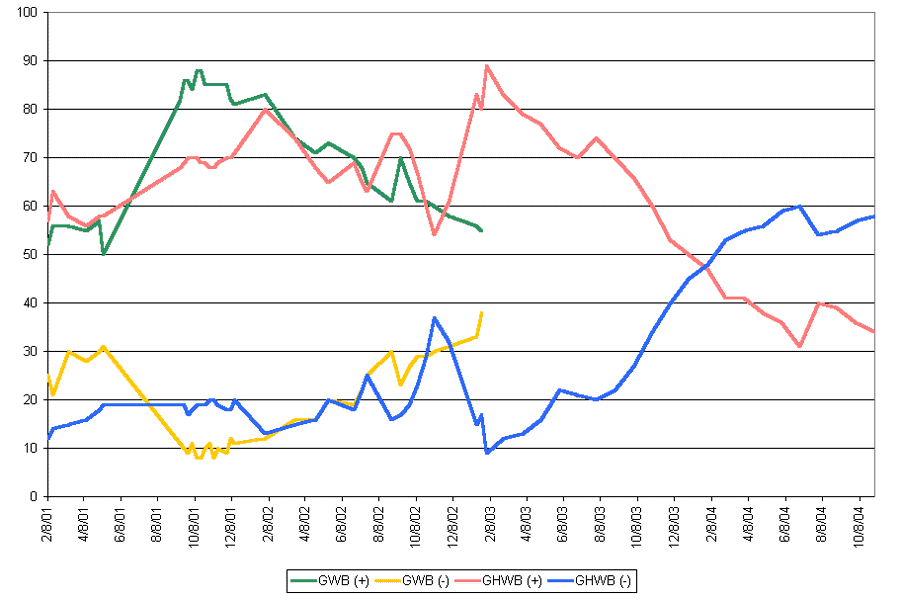
Its interesting to note that George HW Bush's highest ratings came during military actions, the invasion of Panama in mid-1989 and the beginning of the Persian Gulf War in January 1991. George W.'s approvals shot up after 9/11/01, however, like his father's early highs, have been sliding ever since.
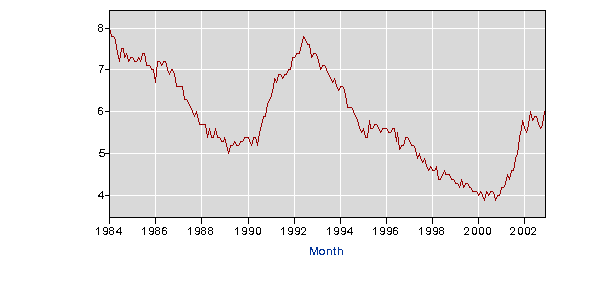
I think that these similar patterns can be accounted for in a number of ways, but correspond most notably with the trends visible in the two graphs below, both from the Bureau of Labor Statistics's website (a great resource, until the current Administration figures a way of pulling it offline):
Unemployment Rates: 1984 - 2003
Monthly Job Losses/Gains: 1984 - 2003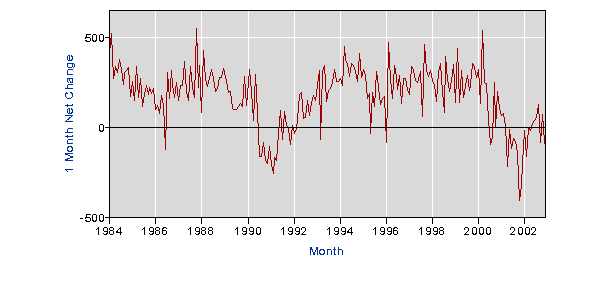
George W. Bush has done a fairly impressive job of convincing the media that he is not his father, and thus will not succumb to the same fate: I think he's done this primarily through asserting he'll never make the "Read My Lips" mistake and alienate his conservative base. Ironically, his economic and social policies are so like his father's that when placed within the context of a similar economic climate, history does in fact appear to be repeating itself.
posted by MB
|
link |
8:11 AM |
Saturday, January 25
On this date...
An astute pundit in Atrios' commentary box yesterday observed in reference to my "Headlines" post,
"that the headlines were from late 1991, which was on the eve of the primary season. Now the Bush administration has an entire year to change the focus from hard times to "morning in America" before the Democrats ramp up their presidential campaigns."
The first part of Dean's concerns I'll address now; the remainder, including a post which I've now been working on for a few days, will have to come later today, as its still not complete. So while I concede that I did purposely include headlines from late 1991, my motivations were pure trickery: Although I removed the year, I wanted the dates to seem recent, and so chose headlines mostly from November and December. However, there was no dearth of material in any of the archives I utilized for a range of dates beginning in late autumn 1990. It is within that premise that every few days for the foreseeable future I will be adding timely flashbacks to news and commentary from the corresponding timeframe within the reign of Bush I.
While my original headlines were chosen in part for their oblique references to particular persons within the first Bush Administration, I'm no longer so constrained. However, although it has been obvious for years now that Bush II has recycled much of his father's staff, it is no less astounding to see it in print, day after day. Funny too, how the journalists and commentators have also remained the same. My first selection is from this date, January 25th, 1991, only a week after GHW Bush invaded Iraq, with the support of the UN Security Council, dozens of European, Arab and Asian allies, and, contrary to contemporary punditry's remarks (last paragraph), high public approval.
A STALEMATE ON THE HOME FRONT IN THE BATTLE TO RESCUE THE ECONOMY
Thomas Oliphant, Globe Staff
January 25, 1991
Page: 19 Section: OP-ED PAGE
WASHINGTON -- On the home front -- where the battle is against stagnation, the squeeze on average families and national decline -- we have no Colin Powells and H. Norman Schwarzkopfs to confidently lead a war with no hands tied behind their backs.
We also have no Patriot missiles, no Wild Weasels to aim at the credit crunch, industrial anemia, and precarious living standards that pose a far more direct threat to American than Saddam Hussein. Instead, lacking anything better from President Bush and Congress, we resignedly tolerate a stalemate at home that would be intolerable in the Persian Gulf.
It is no wonder that with just four days to go until his State of the Union address, Bush tentatively intends to hold its domestic content to a bare minimum, and several of his principal aides count the opportunity to lead another war rally and slide by economic problems as a major blessing.
The direct analogy between all-out commitment in the gulf and bunker mentality at home even extends to the wild mood swings of the last frenetic week. In terms of the economy, what had been a pervasive -- and at least statistically uncalled-for gloom -- was magically transformed into a domestic version of the euphoria that accompanied the first two days of bombing.
Alan Greenspan, the Federal Reserve chairman who comes closer by a country mile than Bush to being our president for domestic affairs, says he can see an end to the recession by summer. He can also see an end to the market fears of major oil supply disruption that have kept the price above $30 per barrel since Iraq's invasion of Kuwait.
Big deal. Hardly anyone (Greenspan included) ever foresaw more than a six- to-nine-month recession of moderate severity by historical standards; and hardly anyone (Greenspan included) saw any economic or military justification for oil supply disruptions. The price spike was produced by speculative fears and disgusting speculative excesses.
In his semiannual flurry of congressional appearances, Greenspan's message that the beginning of the recession's end (even as its existence is just getting formal recognition) is visible was in hand before the war started.
It envisages the bottom, but not only is it guarded, it also envisages nothing remotely resembling the kind of growth necessary to put a serious dent in the deeper problems this country faces in maintaining a strong position in the world with something other than smart bombs.
Greenspan's evidence is mostly of the corner-turning variety following the economy's contraction by about 3 percent of last year's final quarter, and its expected decline by about 2 percent in this year's first quarter. He sees modest inflation, continued growth in exports, a turnaround in auto production, and comfort from the fact that there is no huge overhang in business inventories that could lead to further production cuts, especially if the willingness of consumers to spend (two-thirds of all economic activity) has also turned around with an assist from favorable war news...
Meanwhile, budget deals notwithstanding, the deficit continues to soar out of sight, spurred first by the still-escalating costs of the savings-and-loan bailout, and now of war. It remains true that the more Uncle Sam keeps borrowing the less capital there is for job and productivity-boosting investment.
In this atmosphere, President Bush will do no more next week than try to keep conservatives happy with another stab at a capital-gains tax cut. Democrats probably will counter with a modest cut in payroll taxes.
The result politically is likely to be stalemate, which means the result economically is likely to be stagnation. Generals Powell and Schwarzkopf wouldn't tolerate that kind of war in the gulf, but Bush and Congress want us to tolerate that kind of policy-making at home.
posted by MB
|
link |
2:32 AM |
Wednesday, January 22
Who pays their fact checkers?
I found today's Washington Post article on Bush's plunging poll numbers regarding support for military action against Iraq strangely reassuring, as it re-establishes a modicum of faith in both the American public and the Post's willingness to report bad news for the Administration. In just a few short weeks, support for Bush's Iraq policy has dropped: "50 percent of Americans said they approved of Bush's handling of the Iraqi situation, down from 58 percent a month ago", according to the Washington Post-ABC News poll.
Something, however, which I found somewhat disturbing in the Post's coverage was its willingness to use an outside source's analysis, without checking that source's facts against information available in its own archive. According to the article,
Such levels of support are far below the near-unanimous support for an attack against Afghanistan; support for that operation exceeded 90 percent in the weeks before military action began. Eric Larson, who studies national security and public opinion at the Rand research group, said that was a "unique case" because of the direct link to an attack on U.S. soil. A better comparison, Larson said, was the 1991 Persian Gulf War, when support for war was 45 percent before the attack began but quickly rallied. "In comparison to other historical incidents, this seems to be extraordinarily high support for a military option," Larson said.
The emphasis is mine. The reason I'm fixating on this is that on Monday, I was digging through the Post's archives looking for polls numbers prior to the Gulf War, and came across this article;
GULF POLL MOST AMERICANS WANT HILL TO BACK BUSH
CONGRESSIONAL APPROVAL OF FORCE ALSO FAVORED
Richard Morin Washington Post Staff Writer
January 8, 1991; Page a12
Most Americans want Congress to more actively support President Bush's Middle East policies, but an equally large majority still expects Bush to ask lawmakers before using military force to drive Iraq out of Kuwait, according to a new Washington Post-ABC News Poll The survey also found growing support for Bush's handling of the Persian Gulf crisis, as well as continued strong backing for overall U.S. policy objectives in the region. The survey found that more than six out of 10 Americans support war with Iraq if Iraqi President Saddam Hussein does not withdraw his troops from Kuwait by next Tuesday's U.N. deadline.
But once the shooting starts, public support for a war with Iraq may quickly evaporate in the face of even modest U.S. casualties, according to the poll.
Many Americans remain hopeful that the crisis can be resolved without a war. Nine out of 10 said they supported Bush's decision to have Secretary of State James A. Baker III meet with Iraqi Foreign Minister Tariq Aziz in Geneva Wednesday. And about half of those questioned said that U.S.-Iraqi talks will lead to a peaceful end to the five-month crisis.
Interviews with a national sampling of 1,057 randomly selected adults Friday through Sunday found broad support for the administration's handling of the crisis and growing acceptance of a military solution. Margin of sampling error for the overall results is plus or minus 3 percentage points.
According to the survey, 67 percent of those questioned said they approved of the way Bush was handling the situation in the gulf -- the highest level in a Post-ABC News survey since early September.
Once again, the emphasis is mine. From my search of the WP archives, this is the last WP-ABC poll taken before the start of the war ten days later. Now its quite possible that Larson's information may have been different from the Post's - but its seems to make sense to see if the assertions made by your informants jibe with data which would have a direct bearing on your most current poll, being from the same source and asking the same question, albeit surveyed 12 years previous.
My reasoning behind my search for original documentation (other than it being rather OCD behavior for an archaeologist) was that I wasn't exactly comfortable with the lack of historical perspective in the present-day Iraqi debate. Many people, both in the media and in the blogosphere, have made assertions that Bush's poll numbers would bounce just like his father's once an invasion got under way. Furthermore, its been speculated that if that should in fact happen, Bush II would be unbeatable in the next election. Fortunately, if history does in fact repeat itself (despite my favorite Split Enz song telling me that it doesn't) even with Bush deux's warmongering, a rosy future for him is not at all guaranteed. In fact, the opposite may be true.
I have lots more to write on this, but it will have to wait. I have a 6 year old with a nasty virus who needs to see her ped, and that will not wait.
posted by MB
|
link |
8:14 AM |
California Autism Epidemic Continues: 10 new case per day
[This article comes via the FEAT newsletter. Rick Rollens is a well-known autism advocate, parent of an autistic child, and former Secretary of the California Senate.)
Increases in Autism Diagnosis in California keep rising
From Rick Rollens:
According to the latest figures just released by the California Department of Developmental Services, in 2002 California experienced an astounding 31% one year increase in the number of new children professionally diagnosed with the most severe cases of autism entering it's developmental services system. The 31% one year increase from 2001 to 2002 represents an all time record number of new cases in the system's 33 year history.... 3,577 new severely autistic children added in just the past 12 months. The figures reported by the Department DO NOT include persons with PDD-NOS, Asperger's, or any other autism spectrum disorders, just those who have received a professional diagnosis of level one, DSM IV autism.
According to the Department, eight years ago, in 1994, there were 5,108 cases of level one autism in the entire system, as of January 6, 2003, there are now 20,377 cases of level one autism in the system. From 1971 to 1980, California consistently added one to two hundred new cases a YEAR. In 2002, California added 3,577 new cases. Since 1980, the documented start of California's autism epidemic, the numbers of new cases have exploded to where we are today with California adding, on average, 10 new children a day, 7 days a week with the most severe form of autism to it's system, an increase of over 2 additional new children per day over the 2001 rate of 8 children a day. Keep in mind that from January 1994 to January 1995, California added on average 2 new children a day.....today we are adding 10 children a day.
One only needs to examine the age distribution of the persons in the system to recognize the genesis of this epidemic. Over 81.5% (8 out of 10) of the autism population in the system were born AFTER 1980.... with 2 out of 3 persons in the system currently between the ages of 3 and 13 years old, compared to 18.5% (less then 2 out of 10) who were born BEFORE 1980. Autism now accounts for 40% of all of the new intakes to the system, making level one autism the number one disability entering California's DD system. (The other eligible conditions besides level one autism are mental retardation, cerebral palsy, epilepsy, and other conditions similar to MR.)
posted by MB
|
link |
3:43 AM |
Tuesday, January 21
Around the Blogosphere
Go. Read. Now. (But don't forget to come back and take the Headlines quiz below).
Julia at Sisyphus Shrugged has been all over the Bushies and their attempts to dress up their affirmative action stance in Condi-Colin clothing. (Not putting in a permalink, as you should read the last week's worth, if you haven't already (and why haven't you?))
Lisa at Ruminate This on Freepers, A.N.S.W.E.R. and the growing anti-war protests. Her post is also a fitting response to anti-anti-war-protest sentiment over at Daily Kos.
A little late, but Eric at the Hamster blogs on Senator John Edward's attempts to derail the Bush Administration's assault on the Clean Air Act. (I posted on the new rule changes way back here.)
posted by MB
|
link |
8:22 AM |
Monday, January 20
So what's remarkable about these headlines?
WHEREFORE ART THOU, RECOVERY?
Published on December 5: Charlie Stein, Boston Globe Staff
The latest statistics out of Washington confirm what most people already suspected: The sluggish recovery is threatening to stall altogether.
The economy grew at an annual rate of 1.7 percent in the third quarter, the Commerce Department reported yesterday, down from a previous estimate of 2.5 percent. The revision showed that inventories were higher and sales weaker than originally thought, a pattern that does not bode well for the fourth quarter...
INDEX SHOWS ECONOMY STAGNANT BUSH SAYS, 'WE CAN'T SIT BACK AND HOPE FOR THE BEST'
Published on December 4: John D. McClain, Associated Press
WASHINGTON -- The government's chief measure of future economic health edged up an anemic 0.1 percent in October, casting new doubts on the economic recovery.
"It tells me that whatever recovery we had is gone," said economist Paul Getman of Regional Financial Associates in West Chester, Pa. "The economy is in imminent danger of slipping back into recession."
In Bradenton, Fla., President Bush said he understands the plight of Americans who have lost jobs and...
ECONOMISTS TAKE DIM VIEW OF USING TAX CUTS TO STIMULATE THE ECONOMY
Steven Mufson, Washington Post Staff Writer
December 18; Page a18
It's two and a half times the food stamp program. It's roughly the size of the entire budget of the Transportation Department. It's nearly as big as the contributions the Persian Gulf countries made to cover the cost of Operation Desert Storm. It may be dubbed the Great Tax Giveaway, and it's one of the latest ideas underconsideration by the Bush administration and other Republican leaders. It would give $200 to $300 to every American taxpayer, or a total of $300...
U.S. FACTORY PRODUCTION FELL 0.4% IN NOVEMBER
Steven Mufson, Washington Post Staff Writer
December 17; Page c1
The nation's industrial production fell 0.4 percent last month, the government said yesterday. It was the biggest decline in eight months and a sign that the economy might shrink during the final quarter of the year, analysts said. The drop in output at the nation's factories, mines and utilities was twice as severe as most economists had been expecting and heightened expectations that the Federal Reserve would decide to cut interest rates when its policy-making open market ...
ADMINISTRATION RETRACTS AFFIRMATIVE ACTION CURBS MOVE FAILS TO MOLLIFY CRITICS
Published on November 22, Author(s): Michael K. Frisby, Boston Globe Staff
WASHINGTON -- The White House retreated yesterday from a proposed directive that would have eliminated federal affirmative action programs and crippled private-sector ones. But the action did not quiet a storm of protest over the changes circulated by his legal counsel.
AMERICANS GRADE THEIR HEALTH CARE
Richard Morin, Don Colburn, Washington Post Staff Writers
December 31; Page z6
Most Americans are satisfied with the quality and availability of their health care, but anxieties about cost prompt an overwhelming majority to favor key changes in the health insurance system, a nationwide Washington Post-ABC News poll shows three out of four of those surveyed favor efforts to expand health insurance either by requiring businesses to provide coverage to all employees or by a national health care plan run by the government and financed by taxpayers...
Dream of Striking It Rich Fading in Silicon Valley Technology: Severe business restructuring and recession alter face-and attitude-of electronics Mecca.
The Los Angeles Times; Los Angeles, Calif.; Sep 9; JONATHAN WEBER;
No one believes that Silicon Valley is withering away as a center of innovation. Indeed, it is likely to remain a premier technology hub and a powerful economic driver for the state and nation. But many in the high-tech community agree that when it emerges from the recession, Silicon Valley probably will look more like any other vibrant industrial region rather than ...
State's Long-Term Jobless Corps Grows 50% in Year Recession: Thousands have exhausted their unemployment benefits and are still without a job.
The Los Angeles Times; Los Angeles, Calif.; Sep 8; JESUS SANCHEZ;
Diane Dixon is one of a fast growing number of Californians who have exhausted their unemployment benefits before finding work in a recession-battered job market. The state's corps of long-term unemployed jumped 50% over year-before levels to about 36,000 in July, the latest month for which figures are available from the state Employment Development Department.
TWO VISIONS OF US ENERGY FUTURE
Published on November 4: Ross Gelbspan, Globe Staff
The US Senate's vote Friday to derail action on the Bush administration's massive energy bill provided a vivid reminder of the nation's profound division over how best to provide for its energy needs in the 21st century.
The president's bill foundered primarily on opposition to oil exploration in the Arctic National Wildlife Refuge, but underlying that issue is a far broader disagreement over priorities...
RECORD NUMBER OF JOBLESS LEFT WITHOUT BENEFITS
Chicago Tribune; Chicago, Ill.; Stephen Franklin
The number of workers in the U.S. who have exhausted their jobless benefits and are ineligible for further assistance hit a record high in July, according to a Washington-based research group.
Officials with the Center on Budget and Policy Priorities said that 318,000 workers nationwide, and 17,293 in Illinois, used up their unemployment benefits in July. The nationwide figure is the highest since monthly ...
US EXPECTED TO RESTRICT USE OF RACE-BASED SCHOLARSHIPS
Published on December 4: Anthony Flint, Boston Globe Staff
In a move that is sure to revive a thorny civil rights issue for President Bush, [the] Education Secretary is expected to propose a rule today prohibiting colleges from restricting scholarships to individual racial groups, although race can be a factor in awarding aid.
Under the proposed regulation, scholarships must be open to "all comers," whether white or black or from other groups, a Department of Education official said yesterday...
ADMINISTRATION RETRACTS AFFIRMATIVE ACTION CURBS HINTS OF WHITE HOUSE ADRIFT
Published on November 22: John W. Mashek, Boston Globe Staff
WASHINGTON -- A White House lawyer's attempt to reverse two decades of affirmative action on the eve of a presidential ceremony to sign a new civil rights bill was the most serious of several recent blunders and miscalculations by President Bush and his aides.
The episode, despite Bush's hasty and clumsy attempt to undo the damage, left the president embarrassed and gave the appearance of a White House careening out of control...
PRESCRIPTIONS FOR AN AILING ECONOMY
December 22; Page h1. Washington Post Staff
What is to be done about the economy? Focus on long-terminvestment? Extend jobless benefits? Jump-start housing and construction through federal spending? Cut interest rates even more? As President Bush huddles with his advisers in search of a new strategy, a cross-section of experts offered their advice about the best path to follow...
BUSH APPROVAL RATING SLIPS TO 47%
POLL RESULTS, REFLECTING ECONOMIC FEARS, ARE WORST OF HIS PRESIDENCY
Dan BalzWashington Post Staff Writers
December 17; Page a1
Fed by surging doubts about his handling of the economy, President Bush's popularity has fallen to the lowest level of his presidency, with fewer than half of those questioned in the latest Washington Post-ABC News Poll saying they approve of the way he is doing his job. Bush's approval rating has dropped to 47 percent, marking the first time it has slipped below 50 percent in Post-ABC News surveys. Only about six weeks ago, 59 percent of the public approved of the way he was...
Figured it out yet?
They're all from 1991.
posted by MB
|
link |
6:18 PM |
Friday, January 17
Friendly Ghosts
I don't know if its because he's autistic or just plain three, but my youngest son has become fascinated with our combination fax/answering machine. Its one of the newer ones, with a built-in chip rather than a tape, and stores about 35 messages. I often forget to erase old messages, as it plays only new messages unless cued by a dial on the face of the machine. Its that dial which captured my son Jonah's interest earlier this week. While sitting down at dinner, from the study where the machine is located came a voice literally from the grave. Well, actually two, but in light of Jim Cappozola's poignant essay on the loss of his friend, Richard Silbert, it was the first which has echoed in my head for days. The second was from my mom, who died suddenly a few months ago, but that's a different ghost which haunts me.
Its not that I didn't know the first message was there. From the moment in late September of 2001 when I realized it was still on the machine, I purposely left it there. And every once in a while I think of it. On the first anniversary of the events of September 11th, I actually considered deleting it.
The message is from my friend, James Roux. Like Richard Silbert to Jim C., my relationship with Jim was both professional and personal. He was my son's lawyer in his lead poisoning case, but he was also a savvy political ally and friendly ear. The last time we met was for coffee at Border's, where I sought his advice regarding my recently torched Sienna, and he sought mine regarding a feud with the mayor. I also got a chance to meet his son. The message on my machine was to arrange that meeting.
Jim also told me about a new romance, and his plans to head West to try and arrange for her emigration to the US. A few weeks later, annoyed at his flightiness over my son's case, but otherwise happy for him, I received a letter letting me know he was closing up his practice. It wasn't until September 18th that I read his name on the list of passengers on United flight 175. We were on vacation, and although I had seen the plane, time and time again, flown into the south tower of the WTC, I didn't know my friend was on it. It wasn't until I arrived home and played through all my messages did I find the old one from Jim.
I don't know if it has something to do with reaching a certain point in your life - Jim Capozzola and I are the same age it seems. Does the meaning of mortality somehow change as we go through time? Even though I lost a close childhood friend in my late teens, I hadn't faced death for quite some time until more recently. Then, in the span of four years, I lost both my parents, a couple of friends and very nearly my son. I think of it so much more differently now then when I was young, single and childless. And I'm much more selfish about missing them. The holes their absences leave in my life seem much bigger now, but I also sadly realize that those holes will only increase as I get older, making me into somewhat a block of Swiss cheese.
Fortunately, this aging phase that I'm going through does not let morbidness run amuck, and as soon as I made the cheese metaphor, I started to think about all the positive things about good cheese. Well, in spite of the fact I'm lactose intolerant. And I'm really more of a Havarti-kinda gal. So maybe I need to skip the metaphors. And maybe erase the answering machine.
posted by MB
|
link |
8:36 AM |
Three strikes you're out.
No, not for criminals. For the poor and disabled.
President Bush, circumventing Congressional intent in 1997 Medicaid legislation which moved many benefit recipients into managed care plans, but safeguarded basic care rights, has ruled that states can in fact place restrictions on those protections. The new rules do not specify particular regulations, but many states, such as Louisiana, are looking at limiting emergency room visits to an arbitrary number, such as three per year.
Conservatives often throw out the red herring of Medicaid abuse with stories of the use of ambulances for transportation to routine doctor visits, or using an ER for a hangnail. Medicaid billing fraud, by massive corporations such as the Frist family's HCA, do vastly more to drive up medical costs than the use of emergency rooms by the poor. While there may be instances of misuse, the vast majority of Medicaid recipients work within the system, as best as they can. With fewer doctors taking Medicaid patients due to low reimbursements, many individuals are forced to use emergency facilities for care generally provided in a practitioners' office.
Average Americans need to think hard about what this really means. In order to qualify for Medicaid in most states, you must be either unemployed, disabled, working poor, pregnant or a child from a family of limited means. Under two of those conditions, disabled or pregnant, the very idea of limiting ER visits to three is just simply beyond reason. Serious complications can arise at any hour of the day, not just doctor office hours of 9-5. I personally cannot count the number of times I ended up in the ER in my most recent pregnancy, with complications of placental abruption, hyperemesis and preterm labor. At least twice I've taken my children into the ER in the middle of the night, with symptoms an HMO administrator may not agree were life-threatening. My eldest daughter, presenting with stomach pains, was suffering from an intussusception (bowel blockage). Three years later, my youngest son presented the same symptoms; that time it was severe lead poisoning.
Its now been well documented that the poor suffer more from chronic, yet often life-threatening, conditions such as asthma, diabetes and hypertension. Five thousand deaths are attributed to asthma every years, including hundreds of children. As an asthmatic and the mother of an asthmatic, seldom do attacks occur at times most convenient for our doctors. For the working poor, add to that the limitations imposed by inflexible work schedules.
The Bush Administration, after having foisted a fiscal crisis of catastrophic proportions on state governments through its tax cutting policies, is now waging outright war on the poor, elderly and disabled. The states, begging for the federal government to lift the lifeboat, are instead being told to toss the most vulnerable into the sea.
posted by MB
|
link |
7:31 AM |
Wednesday, January 15
The beginning of the end for the ADA and IDEA?
On January 7th, President Bush began laying the groundwork to dismantle the one significant piece of legislation for which his father is remembered, the Americans with Disabilities Act (ADA). He did this with the nomination of Ohio lawyer and former Justice Scalia clerk, Jeffrey Sutton. However, the danger is not just to the ADA, but to nearly every piece of legislation Congress has enacted under the "Spending Clause", including IDEA, Medicaid, and even the President's pet legislation, No Child Left Behind.
In simple terms, under the "Spending Clause", which derives from the 10th Amendment, Congress seeks to compel states to act in accordance with federal law through its funding of related program, e.g. funded mandates. However, in Alexander v Sandoval, Sutton argued to the Supreme Court that Congress cannot use its power under the Spending Clause to authorize individuals to sue the states to enforce their rights. He argued the same to a Michigan federal court in Westside Mothers v. Haveman, where a group of individuals were suing the state to secure basic medical care under Medicaid for their economically disadvantaged or disabled children. Sutton argued that Medicaid and other Spending Clause laws, such as the Rehabilitation Act and the IDEA, are merely contracts between the federal and state governments, and not supreme federal law. Thus, only the federal government, and not individuals, may take action against the states if the states do not comply with federal laws. In the case of Westside Mothers, the court stated that the only way to enforce Medicaid rights is for the federal government to withhold Medicaid funds to the states -- a ridiculous remedy, as it would result in the same Medicaid recipients still not receiving needed services.
Sutton's attack on the ADA is not limited to the Spending Clause. Fitting a member of the Federalist Society, in Board of Trustees of the University of Alabama v. Garrett, Sutton convinced the Supreme Court’s conservative majority to rule that Congress had no power to allow state employees to sue their employers for damages under Title I of the ADA. In a 5-4 split,
[t]he Supreme Court noted that Congress may not base its abrogation of the states' Eleventh Amendment immunity upon the powers enumerated in Article I. However, Congress may subject non-consenting states to suit in federal court when it does so pursuant to a valid exercise of it power authorized under § 5 of the Fourteenth Amendment. In order to authorize private individuals to recover money damages against the states, there must be a pattern of discrimination by the states which violates the Fourteenth Amendment, and the remedy imposed by Congress must be congruent and proportional to the targeted violation. In the present case, the Supreme Court determined that Congress failed to show in the ADA's legislative history that a pattern of discrimination upon the disabled by the states in employment situations existed, and that there was a need to remedy such discrimination. Therefore, the Supreme Court held that Congress exceeded its constitutional authority by subjecting states to suits in federal court for money damages under the ADA.
In a similar vein, Sutton argued for the state of Georgia before the Supreme Court in Olmstead v. L.C., where he asserted that unnecessarily keeping people with disabilities segregated in institutions versus in community care settings was not a form of discrimination. Sutton also urged the Supreme Court to hold that "the Americans with Disabilities Act does not impose a 'least restrictive treatment' requirement on the States", a ruling which would have profound implications for IDEA and the education of special needs children as well. Fortunately, the present Court rejected this interpretation. For now.
Its important to note that groups which support Jeffrey Sutton's nomination argue that cases such as Garrett are about "state's rights" under the Eleventh Amendment, not rolling back protection for the disabled. Judicial Selection (dot org) asserts that Sutton's arguments in Garrett have been so misinterpreted:
Contrary to what some are saying, Garrett was not about disabilities issues. It was not about rolling back the rights of the disabled. It was about whether Congress could ignore the Eleventh Amendment when it had no constitutional authority to do so.
- The Eleventh Amendment to the Constitution prevents individuals from suing states in federal court.
- Congress may get around this through legislation, but only where it both unequivocally intends to do so and acts under a valid grant of constitutional authority.
- For Congress to get around that part of the Constitution in this case (with the ADA), it would have to show that the states themselves were deliberately discriminating against the disabled.
- Congress did not demonstrate that was happening, at all. Instead, the legislative history of the ADA shows that states were actually engaging in a clear practice of protection and preferential treatment toward the disabled.
- Therefore, Congress had no authority to attempt an end-run around the Constitution.
If Sutton's role in the Garrett case was unprecedented, this argument might hold water. However, throughout his relatively short career (Sutton is only 42), he has time and again sought out cases challenging the rights of the poor and disabled:
Mr. Sutton's role in Westside Mothers is instructive not only for the radical nature of his legal arguments but also for his active, and questionable, intervention into the case. As reported by Nina Totenberg on National Public Radio, Mr. Sutton did not represent any parties in the case. Rather, he purported to represent an organization of municipalities, even though municipalities are not entitled to immunity under the Constitution and had no apparent interest in protecting the states' immunity. However, when the lawyer for the children and families made a routine request to confirm whether the organization's members had authorized Mr. Sutton's involvement, the trial judge denied the request and fined the children and families $6,000. [source: Justice For All]
While I heartily support Dwight Meredith's vision of Democratic "mojo as a renewable resource", one has to wonder if the renomination of Charles Pickering was in fact a cynical attempt to distract attention from even more objectionable, due to age and track record for inflicting widespread damage, nominees. While ADAWatch has been on the case of Jeffrey Sutton since his name first appeared on Bush's wish list back in 2001, the objections of over a hundred civil rights organizations to his nomination to the 6th Circuit have been mostly ignored by the media. In fact, although I was cognizant of Sutton's potential nomination when it was originally discussed, I was not aware that Bush had submitted his name to the Senate until reading Atrios' post during my 5 month-old's 3am breakfast. Kudos to him and Jeff Hauser on not letting this one slip by.
posted by MB
|
link |
8:23 AM |
Tuesday, January 14
A new breed of drug pusher...
The Washington Post this morning has an article on more American kids being prescribed psychiatric drugs. According to the report, a recent University of Maryland study "found that by 1996, more than 6 percent of children were taking drugs such as Prozac, Ritalin and Risperdal, and the researchers said the trajectory continued to rise through 2000."
The study looked at the medical records of 900,000 children either enrolled in Medicaid or a private HMO. There are a number of troubling aspects of this issue, most of which are discussed in the article, such as the lack of research on the long-term effects of these drugs on developing children and increased marketing by pharmaceuticals towards this age group. Also discussed was the possibility that these drugs are being prescribed because they are viewed as less expensive than other methods of treatment, such as counseling or other therapy. Particularly worrisome is the higher prescription rates among lower incomes; "Such powerful medications, normally meant to treat schizophrenia, were increasingly being prescribed to children on Medicaid, said the study's lead author, Julie Zito -- possibly as a way to restrain difficult children."
Although the Post article focuses on the use of these meds to treat psychiatric problems, they seem to miss the fact that many of these drugs, Prozac, Ritalin and Risperdal in particular, are now widely used to treat neurodevelopmental diseases, such as ADHD and autism. And while Risperdal in particular has recently shown promise in use by autistic children, its main benefit was to help them to learn better. But Risperdal also is known to have very serious lifelong side-effects, and no long-term studies have been done in children.
The only proven effective treatment for children with autism and other developmental disorders is Applied Behavioral Analysis, or ABA. ABA is intensive, generally one-on-one therapy, which, according to Lovaas' studies in the 1980s essentially "recovered" approximately 50% of its participants, and led to significant improvement in nearly the remaining 50%. ABA is the preferred therapy in many school districts around the US, including my own. Problem is, its very expensive, with per pupil costs generally surpassing $50K per year. Of course, in the long run its also cost effective, as 50% of its participants not only do not need the life-long care previously required for almost all individuals with autism, they are "indistinguishable from their peers", requiring few, if any, further special education assistance. But in the short run, in light of looming budget deficits, ABA seems a perfect target for the budget axe.
One would think that the safeguards incorporated in IDEA would protect students from such cuts. Currently, those protections are there, but often school districts, when given the choice between litigation and providing children expensive services, will forego the latter for the former, gambling on many American's reluctance to sue those they're supposed to trust, their children's school. In addition, proposed changes in IDEA by the Bush Administration could have a profound effect on the interpretation of IDEA , particularly by Bush's new federal bench. Its quite possible that the benchmarks used to ascertain "improvement" may be modified to favor those more easily accomplished by merely medicating, rather than actually teaching, our special needs children, and at a greatly reduced cost over methods such as ABA.
The big winners in all this are the pharmaceuticals, some currently under the IOM's microscope as possible culprits in the increase of neurodevelopmental disorders. The irony of it all.
posted by MB
|
link |
9:27 AM |
Sunday, January 12
So why is it the actor who plays the President acts more Presidential than the man appointed as President?
Actor Martin Sheen leads anti-war rally
AFP - US movie star Martin Sheen on Saturday led thousands of people in a rowdy protest march in Los Angeles against President George W Bush's plans for a possible war with Iraq.
Sheen, who plays a fictional US president on the hit television show The West Wing, called for Americans to fight for a peaceful approach to the Washington administration's crisis centring on Iraqi leader Saddam Hussein.
"A lot of people have been silenced for a long time but that is ending," he said.
"We are telling the world that we are patriotic Americans but we do not support going to war with Iraq.
"From this time forth, may all our thoughts and deeds be a non-violent response to violence," he told the cheering crowd.
Funny, I can actually picture him saying this, with his hands in his pockets, of course.
[link via Skippy]
(as a side note, I'd like to point out that nearly an equal number of Mainards came out to protest racism against Somalis yesterday)
posted by MB
|
link |
6:21 AM |
Saturday, January 11
Maybe the not-so-"liberal" media is finally getting a clue
This AP story has been picked up by a couple dozen news outlets in the past two hours. Certainly doesn't portray our Dr. Senator in the most positive light.
WASHINGTON -- Shortly after Sen. Bill Frist introduced legislation limiting suits against vaccine makers, the drug industry's trade group gave $10,000 to the surgeon-turned-politician's political action committee.
Throughout his political career, the new Senate majority leader has supported the health care industry and the industry has supported him.
Frist, R-Tenn., has raised more than $2 million from doctors, health insurers, drug companies and others in the health care industry. That's roughly 20 percent of all the contributions to his two Senate campaigns.
Here's the rest of the story.
posted by MB
|
link |
5:55 PM |
Here's a novel approach to concealing racist intent:
Rep. Wayne Pettigrew wants the public to know that he’s after historical accuracy, not bringing up specters of a painful part of American history in his effort to have the Cherokee Brave Confederate flag flown at the [Oklahoma] state Capitol plaza.
However, one African-American lawmaker and a spokesman for the Cherokee Nation both question Pettigrew’s motives and historical accuracy....
Apparently, the only difference between the first National Flag of the Confederacy ("Stars and Bars") and the Cherokee Brave flag is the latter has five red stars in the center of a circle of white stars. And the words "Cherokee Brave" that Pettigrew wants to remove.
Read the whole article. The audacity of Pettigrew, who is not an Indian, is beyond description.
posted by MB
|
link |
12:28 PM |
At least someone knows how to handle the Bushies
Winnebago Tribe gives BIA eviction notice
The Winnebago Tribe of Nebraska gave the Bureau of Indian Affairs a 30-day eviction notice Wednesday, claiming the bureau hasn't paid rent for five years.
"We have given BIA officials numerous opportunities to clear up their delinquency, but at some point enough is enough," said Winnebago Tribal Chairman John Blackhawk. "The BIA has simply got to get their act together if they expect to be taken seriously by tribal governments. Hopefully this will serve as a wake-up call to federal officials."...
"The BIA already has a long track record of financial irresponsibility," he said. "Clearly their fiscal affairs are a mess from top to bottom."
The tribe claims the BIA owes nearly $200,000 in unpaid rent on the building, where 30 BIA workers provide services to the Winnebago, Omaha and Santee reservations....
Wednesday, the tribe changed the building's locks and disconnected its electricity and phone service.
With a trillion dollar deficit looming if Bush gets his economic plan, can the American people do the same for the White House?
posted by MB
|
link |
11:50 AM |
Bigotry and hope in a small New England city
When it comes to reporting the upcoming white-separatist and "Many & One" rallies in Lewiston today, Canadian media has its counterparts in the US beat.
The rallies start in less than an hour, with security the tightest its ever been for an event in Maine. My spouse and six-year old daughter left for the diversity rally at Bates College a few minutes ago, and I can't say that I didn't experience a bit of a twinge as they left. Its been speculated that due to World Church of the Creator grand-wizard (or whatever he calls himself) Matthew Hale's arrest earlier this week for soliciting the murder of a federal judge, the possibility for violence has increased exponentially. Various groups from outside of Maine have also rolled into Lewiston, vowing to confront the racists.
If the idea that racism and bigotry would find itself at home in lefty, crunchy Maine surprises anyone, a brief history lesson is in order. In the 1920s and 30s, Maine had the highest per capital membership in the KKK outside of the Deep South. With a membership of between 50-150,000 statewide, white knights and their families flocked to openly advertised meetings, picnics and "socials", including one in Portland which drew a crowd of upwards of 15,000. Ralph Owen Brewster was elected governor in 1924 with the open endorsement of the Klan, and a Klansman was elected mayor of Portland. I suspect my own home was built in 1914 by a Klansman, whose day job was the city tax assessor. That was the same time my Indian gr-grandparents were running a laundry in the West End, down the street from various other Klan members' homes, some built by the talented J.C. Stevens.
But how could this be, with Maine's African-American population of less than 1%? In Maine, however, the target of the Klan's wrath was not its black population, which frankly was experiencing internecine problems at the time between the long-standing middle-class freeman community, and new emigrants freed during the Civil War. Maine's Protestant Yankee bigotry was aimed at its large Franco-American and Indian communities (in the western half of the state, the two were often indistinguishable due to significant intermarriage.) Laws banning French in school and denial of state suffrage for Indians until the mid-1950s were largely the work of Klan members, most of whom never bothered to hide their identities behind hoods. Racial riots in Lewiston and Waterville were often provoked, and more than a few "wood niggers", as we were called, "went missing", only to be found in the Kennebec River or tied to a tree. My great-grandmother's uncle, a veteran of the highly decorated Maine 19th, was one such victim, prompting his remaining family to flee to the relative safety of Portland. But by the 1920s, even the city wasn't safe. My grandfather, who died only a few years ago at age 80, remembered clearly the taunts and physical blows he endured in the schoolyards of Portland. Some of those offending classmates, here and throughout Maine, including Lewiston, may be ancient but living, and the bigotry they heard around the kitchen table, or at the Klan picnic, passed from one generation to the next. Every once in a while it raises its ugly head, whether in the form of "concern" over Somali refugees or the rejection of protections for gays and lesbians.
We'll find out today at the rally just how deep Maine has buried its racist past. Hopefully, deep enough that the thousands of feet at the pro-diversity rally can tamp it down so we never see it spring forth again. My daughter's small feet are there to help do just that.
posted by MB
|
link |
10:45 AM |
Friday, January 10
Hot off the presses...
I guess Wolf Blitzer's poll yesterday (75% for holding vaccine manufactures accountable) held some sway with the Mayberry Machiavellis. From Boston.com:
Vaccine makers' protection will be eliminated, Republicans say
WASHINGTON (AP) Republicans said Friday they would reverse several favors to special interests in the Homeland Security law, including a much-criticized provision to limit lawsuits against vaccine makers.
House and Senate Republicans said they also would get rid of a loophole under which companies that locate overseas to avoid paying taxes could still compete for agency contracts, and would revise language that gave one university, Texas A&M, special access to federal research money.
Senate Majority Leader Bill Frist, R-Tenn., who supported the original vaccine provision and said he still hopes to take up the issue later this year in more comprehensive legislation, said he would include the special interest eliminations in a fiscal 2003 spending bill the Senate will take up this month.
Get me some Kleenex:
Lilly, in a statement, said it was disappointed by the decision to repeal the vaccine provision but pleased by the promise to take up comprehensive vaccine legislation in the first half of 2003. It said there is no scientific evidence linking Thimerosal to autism.
Hmmmm...not exactly what the IOM says, but I'm open to debating it on its merits.
Kudos to Snowe, Collins and Chafee.
posted by MB
|
link |
4:18 PM |
Thursday, January 9
A wee bit of intrigue brewing...
From Yahoo News, regarding the Eli Lilly provision in the HLS bill:
[Sen. Patrick] Leahy on Tuesday joined Sen. Debbie Stabenow (D-MI) in introducing legislation that would repeal the provision enacted in November, which Stabenow said "takes away the legal rights of parents to protect their children." Reps. Tom Allen (D-ME) and Dennis Kucinich (D-OH) are introducing a House version of the bill.
Meanwhile, a second group of lawmakers is working on another approach, which would modify but not repeal the language in question. Just before the Senate passed the bill, Maine Republican Senators Olympia Snowe and Susan Collins, along with Lincoln Chafee (R-RI), threatened to block the bill until House and Senate GOP leaders promised them the language would be revisited in January.
A spokesman for Snowe said the senators have been working with Sen. Judd Gregg (R-NH), the incoming chairman of the Senate Health, Education, Labor and Pensions Committee, on language that would clarify parents' ability to use the federal vaccine compensation program for thimerosal claims, even if their children's injuries occurred outside the normal three-year time limit.
Since I just got off the phone with Senator Snowe's office, I plan on withholding judgement until I see how the chips fall on this one. The Senator's healthcare staff have been very accomodating and gracious, and I only hope that she's able to stand her ground. In the meantime, keep calling and faxing those Senators, reminding them that as it currently stands, hundreds of thousands of kids are left out in the cold.
posted by MB
|
link |
10:25 AM |
Know the Cause, Find the Cure Rally coverage
Today's blogging will cover yesterday's rally in Washington. But first, click on over to Wolf Blitzer's website at CNN to see his poll for the day: Should Americans be able to sue companies that make vaccines?
As of 7:30am EST, 72% of respondents said yes.
Here's the bill, S-105.
Ms. Stabenow introduced the following bill; which was read twice and referred to the Committee on ___________________________. A BILL to repeal certain provisions of the Homeland Security Act (Public Law 107-296) relating to liability with respect to certain vaccines, and for other purposes.
1 Be it enacted by the Senate and House of Representa-
2 tives of the United States of America in Congress Assembled,
3 SECTION 1. REPEAL OF CERTAIN VACCINE LIABILITY PRO-
4 VISIONS
5 (a) IN GENERAL. ----The Homeland Security Act of
6 2002 (Public Law 107-296) is amended ---
7 (1) by repealing sections 1714, 1715, 1716, and
8 1717; and two
1 (2) in the table of contents, by striking the
2 items relating to sections 1714, 1715, 1716, and
3 1717.
4 (b) EFFECTIVE DATE. --- This section shall take effect
5 as though enacted as part of the Homeland Security Act
6 of 2002 (Public Law 107-296).
The cosponsors of S-105, as of yesterday, are:
Sen Boxer, Barbara (D-CA)
Sen Daschle, Thomas A. (D-SD)
Sen Dayton, Mark - (D-MN)
Sen Dodd, Christopher J. (D-CT)
Sen Dorgan, Byron L. - (D-ND)
Sen Durbin, Richard J. - (D-IL)
Sen Feinstein, Dianne - (D-CA)
Sen Landrieu, Mary L. - (D-LA)
Sen Lautenberg, Frank R. - (D-NJ)
Sen Leahy, Patrick J. - (D-VT)
Sen Levin, Carl - (D-MI)
Sen Sarbanes, Paul S. - (D-MD)
Below are the list of Democrats and moderate Republicans needed to pass Sen. Stabenow's bill. Please call and fax them requesting that they cosponsor the legislation. Faxing is most effective, as all faxes are logged.
Blanche Lincoln (D - AR) (202) 228-1371 (fax) (202) 224-4843 (phone)
Mark Pryor (D-AR) (202) 228-0908 fax (202) 224-2353 (phone)
John McCain (R - AZ) (202) 228-2862 (fax) (202) 224-2235 (phone)
Joseph Lieberman (D - CT) (202) 224-9750 (fax) (202) 224-4041 (phone)
Joseph Biden, Jr (D - DE) (202) 224-0139 (fax) (202) 224-5042 (phone)
Thomas Carper (D - DE) (202) 228-2190 (fax) (202) 224-2441 (phone)
Bob Graham (D - FL) (202) 224-2237 (fax) (202) 224-3041 (phone)
Bill Nelson (D - FL) (202) 228-2183 (fax) (202) 224-5274 (phone)
Zell Miller (D - GA) (202) 228-2090 (fax) (202) 224-3643 (phone)
Daniel Akaka (D - HI) (202) 224-2126 (fax) (202) 224-6361(phone)
Daniel Inouye (D - HI) (202) 224-6747 (fax) (202) 224-3934 (phone)
Tom Harkin (D - IA) (202) 224-9369 (fax) (202) 224-3254 (phone)
Evan Bayh (D - IN) (202) 228-1377 (fax) (202) 224-5623 phone)
John Breaux (D - LA) (202) 224-2435 (fax) (202) 224-4623 (phone)
Edward Kennedy (D - MA) (202) 224-2417 (fax) (202) 224-4543 (phone)
John Kerry (D - MA) (202) 224-8525 (fax) (202) 224-2742 (phone)
Barbara Mikulski (D - MD) (202)224-8858 (fax) (202) 224-4654 (phone)
Paul Sarbanes (D - MD) (202) 224-1651(fax) (202) 224-4524 (phone)
Susan Collins (R - ME) (202) 224-2693 (fax) (202) 224-2523 (phone)
Olympia Snowe (R - ME) (202) 224-1946 (fax) (202) 224-5344 (phone)
Max Baucus (D - MT) (202) 228-3687 (fax) (202) 224-2651 (phone)
John Edwards (D - NC) (202) 228-1374 (fax) (202) 224-3154 (phone)
Kent Conrad (D - ND) (202) 224-7776 (fax) (202) 224-2043 (phone)
Ben Nelson (D - NE) (202) 228-0012 (fax) (202) 224-6551 (phone)
Jon Corzine (D - NJ) (202) 228-2197 (fax) (202) 224-4744 (phone)
Jeff Bingaman (D - NM) (202) 224-2852 (fax) (202) 224-5521 (phone)
Harry Reid (D - NV) (202) 224-7327 (fax) (202) 224-3542 (phone)
Charles Schumer (D - NY) (202) 228-3027 (fax) (202) 224-6542 (phone)
Hillary Clinton (D - NY) (202) 228-0282 (fax) (202) 224-4451 (phone)
Ron Wyden (D - OR) (202) 228-2717 (fax) (202) 224-5244 (phone)
Arlen Specter (R - PA) (202) 228-1229 (fax) (202) 224-4254 (phone)
Lincoln Chafee (R - RI) (202) 228-2853 (fax) (202) 224-2921 (phone)
Jack Reed (D - RI) (202) 224-4680 (fax) (202) 224-4642 (phone)
Ernest Hollings (D - SC) (202) 224-4293 (fax) (202) 224-6121 (phone)
Thomas Daschle (D - SD) (202) 224-7895 (fax) (202) 224-2321 (phone)
Tim Johnson (D - SD) (202) 228-5765 (fax) (202) 224-5842 (phone)
Bill Frist (R - TN) (202) 228-1264 (fax) (202) 224-3344 (phone)
Jim Jeffords (I - VT) (202) 228-0776 (fax) (202) 224-5141 (phone)
Patty Murray (D - WA) (202) 224-0238 (fax) (202) 224-2621 (phone)
Maria Cantwell (D - WA) (202) 228-0514 (fax) (202) 224-3441 (phone)
Russell Feingold (D - WI) (202) 224-2725 (fax) (202) 224-5323 (phone)
Herb Kohl (D - WI) (202) 224-9787 (fax) (202) 224-5653 (phone)
Robert Byrd (D - WV) (202) 228-0002 (fax) (202) 224-3954 (phone)
John Rockefeller IV (D - WV) (202) 224-7665 (fax) (202) 224-6472 (phone)
Buried in the middle of those numbers are those for the Senate Majority Leader, William Frist. He in particular needs to hear that this is not something which has been forgotten over the December holiday.
posted by MB
|
link |
4:47 AM |
Wednesday, January 8
Around the web...
My two favorite sports rolled into one: Basketball and payback (and from the Moonie Times - what's up with that?):
DENVER — Don't be surprised if the hottest ticket in college basketball this season turns out to be a match between the Fighting Whites and the North American Stealers.
The pride of the University of Northern Colorado, the Whites won only two games in their intramural basketball league last year, but their idea of turning the tables on schools with American Indian mascot names has spread like wildfire.
Students at a handful of colleges across the rural West and Indian country are considering forming their own Fighting Whites-style intramural teams this season, inspired by the success of the team, first planned as "the Fightin' Whities," in drawing national media attention to the mascot issue.
An intriguing tidbit further down:
The Whites concede that some T-shirt buyers missed the point and saw them as a statement of white pride. Likewise, when a conservative Web site, FreeRepublic.com, ran a story about the North Dakota art exhibit, it was flooded with responses from readers asking where to buy the jerseys.
"Cleveland Honkies! Where do I buy it? I think I'd pay $100 for a jersey so emblazoned. I'm completely serious," said one e-mailer.
Speaking of payback...Ron Brownstein in the LATimes lays out Bush's underlying tax cut agenda:
WASHINGTON -- The huge new round of tax cuts President Bush proposed Tuesday, building on policies he has already advanced, could reshape the federal government's role in society as profoundly as the tax and spending plans President Reagan drove into law more than 20 years ago.
By proposing nearly $700 billion in additional tax cuts when the government is already facing large budget deficits and projecting steady increases in military spending, Bush has laid out a fiscal blueprint that could constrict spending for years to come on the domestic priorities Democrats favor.
The Eli LillyPizza Payoff?
Described as the "pizza rule" by both Republicans and Democrats, the measure would allow outside interests to pay for "perishable food or refreshments offered to members of an office." Last year, for example, a lobbying firm representing pharmaceutical interests sent in dinner for House Speaker J. Dennis Hastert's (R-Ill.) staff while they were working late on a prescription drug bill....
Ethics committee chairman Joel Hefley (R-Colo.) said he had objected to the change, but was overruled by GOP leaders....
But Hefley said he hopes to revisit the issue. "I don't think anyone can be bought for a piece of pizza, but I think it looks bad," he said. "Part of our job is to avoid the appearance of evil, as well as evil."
posted by MB
|
link |
7:00 AM |
Tuesday, January 7
FOR IMMEDIATE RELEASE
Parents of Children Exposed to Mercury-Laden Vaccines Hold DC Rally to Support Repeal of Homeland Thimerosal Liability-Shield Provision
WASHINGTON, DC, Jan. 7 -/E-Wire/-- Parents of autistic children and their supporters will gather on Capitol Hill for the "Know the Cause, Find the Cure" rally to support legislation to repeal the Homeland Security Act's thimerosal-liability-shield provision. The event will take place at Upper Senate Park near the Senate Russell Office Building starting at 9:00am on January 8th.
At 10:15 A.M., US Senator Debbie Stabenow (D-MI), joined by several other Members of Congress, parents and their children, and advocates, will announce legislation to remove provisions inappropriately snuck into the Homeland Security Act at the last minute. These provisions give Eli Lilly and other vaccine makers a "get-out-of-court-free card" by stifling legal recourse for thousands of autistic children exposed to mercury through infant vaccines.
Autism Spectrum Disorder (ASD) now affects approximately 1 in 150 American children, according to a recent Centers for Disease Control investigation---up from 2 in 10,000 prior to 1980. The recent tracking of autism cases by the state of California indicates a connection between ASD and the number of thimerosal-laden vaccines administered to infants which resulted in mercury exposures many times over levels considered "safe" by federal agencies. In 2001, the Institute of Medicine released a report also suggesting the link between autism and thimerosal is "biologically plausible." Currently there is no cure for autism.
SOURCE: Mercury Policy Project
According to the Boston Globe, in addition to Senator Debbie Stabenow, who will introduce the legislation at the rally during a press conference (scheduled for 11:15 a.m. near the fountain at Upper Senate Park on the corner of Constitution and Delaware), various other members of Congress, including Representative Dan Burton (R-IN) and Senator Patrick Leahy (D-VT) are also expected to speak in support of the new legislation.
On December 11th, Stabenow vowed to fight the special-interest provisions. "The provision approved in the Homeland Security bill would severely limit parents' ability to get justice for their children," she said. "Instead of just creating a department to protect American families-which it is intended to do-this bill seems to be protecting the financial interest of a company whose CEO was in the top five for compensation in 2001, a company which posted $11.5 billion in revenue in 2001, and a company in an industry that makes higher profits than any other industry."
The rally is sponsored by the Autism Autoimmunity Project . This is the current schedule of events for January 8th:
7:30 - 9:00 a.m. - Set up/Videos on Display/Pass out Packets
8:45 a.m. - Adopt a chair throughout rally
9:00 a.m. - Welcome/Overview/April Oakes and Ray Gallup
9:15 a.m. - Congressman Burton
9:45 a.m. - Senators
10:15 a.m. - Break for refreshments/Picket/Raffle Giveaways
10:45 - Lyn and Sallie from Safe Minds
11:30 a.m. to 2:15 p.m. - Picket/Stabenow’s Press Conference/Dr. Yazbak
2:15 p.m. - Michael Bender from the Mercury Policy Project
2:45 p.m. - Break for refreshments/Picket/Raffle Giveaways
3:15 p.m. - Senators
4:45 p.m. - Break for refreshments/Picket/Raffle Giveaways
5:00 p.m. to 6:00 p.m. - Picket/Free Time
6:00 p.m. - Dedication to our children/Moment of Silence/Closing Prayer
6:10 p.m. to 7:00 p.m. - CLEANUP
In addition to those who can attend, TAAP will have set up 300 chairs for families who cannot attend due to the overwhelming circumstances of raising a child or children with autism. These chairs will, however, have photos of their sponsored children so that they can attend in spirit.
posted by MB
|
link |
10:40 AM |
|
|
|
 |
|