Sunday, May 25
Today is the day...
Most of the bugs are worked out over on the new site, so I guess there's no good reason to keep double posting.
Update your bookmarks!
Wampum has formally moved to:
Old Wampum archives will remain on Blogspot until I can figure out how to move them without mangling them, as I did yesterday. [Note to self: Don't attempt complicated technical maneuverers when feeling like death-on-toast.]
posted by MB
|
link |
5:32 AM |
Saturday, May 24
Krugman explains it all
If you're at all the neophyte econoholic I am, deflation is one of those concepts you sort of grasp, but know there's a whole lot more you don't get. Fortunately, that's where Professor Krugman comes in. In his latest column, he not only tackles deflation, but cues us in on the dangers of a good old fashion, but little known concern:
The particular type of quagmire to worry about has a name: liquidity trap. As the I.M.F. report explains, the most important reason to fear deflation is that it can push an economy into a liquidity trap, or deepen the distress of an economy already caught in the trap.
Here's how it works, in theory. Ordinarily, deflation — a general fall in the level of prices — is easy to fight. All the central bank (in our case, the Federal Reserve) has to do is print more money, and put it in the hands of banks. With more cash in hand, banks make more loans, interest rates fall, the economy perks up and the price level stops falling.
But what if the economy is in such a deep malaise that pushing interest rates all the way to zero isn't enough to get the economy back to full employment? Then you're in a liquidity trap: additional cash pumped into the economy — added liquidity — sits idle, because there's no point in lending money out if you don't receive any reward. And monetary policy loses its effectiveness.
Once an economy is caught in such a trap, it's likely to slide into deflation — and nasty things (what the I.M.F. report calls "adverse dynamics") begin to happen. Falling prices induce people to postpone their purchases in the expectation that prices will fall further, depressing demand today.
Also, deflation usually means falling incomes as well as falling prices. In a deflationary economy, a family that borrows money to buy a house may well find itself having to pay fixed mortgage payments out of a shrinking paycheck; a business that borrows to finance investment may well find itself having to pay a fixed interest bill out of a shrinking cash flow.
In other words, deflation discourages borrowing and spending, the very things a depressed economy needs to get going. And when an economy is in a liquidity trap, the authorities can't offset the depressing effects of deflation by cutting interest rates. So a vicious circle develops. Deflation leads to rising unemployment and falling capacity utilization, which puts more downward pressure on prices and wages, which accelerates deflation, which makes the economy even more depressed. The prospect of such a "deflationary spiral," rather than the mere prospect of deflation, is what scares the I.M.F. — and it should. One of the things which strike me as eerie each week when I run through the 1991 news archives is that stories of Japan, whose economy made our manufacturing sector tremble, our trade protectionists rail to the point of bigotry and our President chuck on the Japanese Prime Minister, filled every financial section in every paper, day after day. They were our largest competitor in the sprint for the world's markets, and we were prepared for that race to last decades.
How, in just a few short years, times have changed. The meltdown of the Japanese economy in the late '90s seems to have erased a great deal of our national not-always-so-friendly rivalry, which has shifted elsewhere (China?) For many right-wing media outlets always happy to whip up anti-Japanese sentiment in the 80's, the Japanese are now too much of a non-entity to even bother with. What the dismantling of the Soviet Union did for the political Cold War, the collapse of the Japanese market did for the economic Cold War.
Is it possible that the US could be following in the footsteps of Japan? Krugman approaches that question hypothetically. I, on the other hand, waiting for take our Chinese, picked up a local real estate booklet. One thing I remember of the time I spent in Japan after finishing my undergrad study was the Tokyo real estate boom. I was shocked to see prices have skyrocketed in the Portland area, just in the past few months since I last picked up one of these flyers. At the same time, layoffs are on the rise, and most likely will continue, with pending budget cuts and the exporting of more manufacturing and technology jobs overseas. While a crash of the housing market is only one piece of a deflating market, seeing it so close at hand was rather startling.
The one piece of good economic news in Maine. With US dollar falling against the Canadian, maybe the Quebecois tourists will return for the first time in a decade. That is, if the Bushies don't stop all Francophones at the border.
posted by MB
|
link |
11:55 AM |
Friday, May 23
Moving the lodge!
I can't believe it, I finally figured it out. Movable Type, that is. I'll be posting on both sites until I'm sure I've got it down, as well as getting all my archives moved over. But my new home is..(drumroll, please)...
wampum.wabanaki.net
Wabanaki.net is one of the few Indian-owned and operated hosting sites, so it'll be great to be back on rez again.
(note: I'm finally able to begin fix my blogroll which was eaten not once, but three times, by Blogger. My regrets to all my friends who mysteriously disappeared over the past month - I'm hoping Movable Type is not so buggy.)
posted by MB
|
link |
9:11 AM |
Whodda thought?
While doing my early morning deja vu research, I ran across this column that I thought too good not to post all by itself:
QUEEN ELIZABETH AND THE BUSH BLACK SHEEP
Donnie Radcliffe, Washington Post
Column: WASHINGTON WAYS
May 21, 1991
The Queen of England got two George Bushes for the price of one when she arrived at the White House last Tuesday. What she didn't know was that the president's eldest son, George Walker Bush, so unpredictable that the family never knows what he'll say in polite society, was under strict orders from his parents not to address the queen. Somehow, though, he and the queen got to talking anyway. About boots, the new pair he was wearing, made especially for the occasion. Usually he has them printed with something like "Texas Rangers." Was that on these boots, the queen wanted to know.
"No, ma'am," George replied. "God Save the Queen."
The queen thought that so jolly good that she further fueled their exchange with another question. Was he the black sheep in the family? she inquired.
"I guess so," he admitted.
"All families have them," observed the queen.
"Who's yours?" asked George.
"Don't answer that!" cut in Barbara Bush, appearing from out of nowhere.
And in her queenly manner as she walked away, Elizabeth II did not.
posted by MB
|
link |
4:31 AM |
Thursday, May 22
I'll see you on that vote, and raise you one cake...
Atrios, challenging W to a winner take all (votes) wager, writes:
The Bush administration is claiming that there will average 306,000 net new jobs per month over the next 18 month. If that happens, I promise to vote for him. Now, what will he promise if it doesn't? I thought about putting up all kinds of pretty charts and graphs, but you know, I'm just too damn sick today with some psuedo-SARS bug, so I just crunched the numbers from the BLS and here's the bottom line: Clinton, the job-making machine of this half-century only averaged 268,000 jobs a month. If Bush can do 306,000 jobs a month, I'll not only vote for him, but jump out a cake at his inaugural.
posted by MB
|
link |
5:15 PM |
And it's not even Flashback Friday yet
I realize that Josh Bolten has been lurking around the West Wing for the first few years of Bush Deux, where his duties ran towards secretly developing the Office of Homeland Security, intervening with the Treasury Department for Enron, and figuring out how to sell steel tariffs.
But this move shines a spotlight on a man known to jealously guard his, and the Administration's, privacy:
Bolten to Be Named OMB Director
Bush's Intensely Private Deputy Chief of Staff to Replace Daniels
By Mike Allen
Washington Post Staff Writer
Thursday, May 22, 2003
President Bush plans to name Joshua B. Bolten, a deputy White House chief of staff, as his new budget director, administration officials said yesterday.
Bolten is to replace Mitchell E. Daniels Jr., who announced earlier this month that he plans to return to Indiana in June, probably to run for governor next year.
Bolten, a silver-haired former Goldman Sachs executive, is soft-spoken and intensely private. His appointment as director of the Office of Management and Budget will bring a major shift in style to the job and appears to be an effort to improve White House relations with lawmakers, many of whom were rankled by the blunt, aggressive style of Daniels. Ironically, this position is much closer to his previous one in the first Bush Administration:
Appointment of Joshua B. Bolten as Deputy Assistant to the President and Director of the Office of Legislative Affairs
March 18, 1992
The President today announced his intention to appoint Joshua B. Bolten, of the District of Columbia, to be Deputy Assistant to the President and Director of the Office of Legislative Affairs. He would succeed Stephen T. Hart, who will be joining the Department of Transportation as a Deputy Assistant Secretary for Industry Liaison.
Since 1989, Mr. Bolten has served as General Counsel at the Office of the U.S. Trade Representative. Previously he served as international trade counsel to the U.S. Senate Committee on Finance. In 1984 - 85, prior to joining the finance committee, Mr. Bolten was in private practice in international trade law with the Washington, DC, office of O'Melveny & Myers. From 1981 to 1984, he worked in the Office of the Legal Adviser at the Department of State, providing legal counsel primarily to the Bureau of Inter-American Affairs. He also served as executive assistant to the Director, Kissinger Commission on Central America. During 1980 - 81, Mr. Bolten served as a law clerk at the U.S. District Court in San Francisco. When I first found this biographical piece, I didn't read it very closely. Later, as I was writing this post, heading in different direction altogether, I noticed Bolten's tenure with State, and his involvement with Inter-American Affairs in particular, during the early 80's. Those were the years just prior to Iran-Contra, when US Central American policy was more focused on a peasant uprising in the tiny country of El Salvador. I spent my first years in college under the tutelage of Bob White, Carter's final ambassador to El Salvador, a man who saw 30 year foreign service career evaporate after he interfered with CIA funding of D'Aubuisson's death squads. That Bolten cut his political eye teeth in the BIAA during that time sends shivers up my spine: Even more disconcerting is that he is the son of long-time CIA insider, Seymour Bolten, who also happened to be George H.W. Bush's assistant director for operations in the mid-'70's. The OMB has been tainted for years by the Mitch Daniels-Eli Lilly-George HW Bush connection, which included Bush's tenure on the Lilly Board of Directors, being sanctioned by the Supreme Court while VP for lobbying the IRS on behalf of Lilly and other drug companies, and choosing Lilly-heir Dan Quayle as his running mate. Having another OMB director with dubious Bush Sr. ties makes me want to pull out my tinfoil hat.
Time to buy stock in Reynold's Wrap.
posted by MB
|
link |
12:18 PM |
Unemployment claims on the way up again
After two weeks where the number appeared to be on the decrease, new jobless were up sharply again in this morning's report:
In the week ending May 17, the advance figure for seasonally adjusted initial claims was 428,000, an increase of 7,000 from the previous week's revised figure of 421,000. The 4-week moving average was 433,000, a decrease of 7,750 from the previous week's revised average of 440,750. Of course, last week's figure was once again revised upwards from 417,000 by 4K jobs, so the week-to-week pre-revised increase was 11K.
Update: As I speculated last week, layoffs in the public sector are increasing due to budget cuts: New claims for federal employees were up 16% last week. I suspect that number will only grow in the weeks to come.
posted by MB
|
link |
5:43 AM |
Wednesday, May 21
Rats deserting a sinking ship?
Something to wish for, but somehow I doubt that is the case:
Whitman, E.P.A. Administrator, Submits Resignation
By THE ASSOCIATED PRESS
May 21, 2003
WASHINGTON -- Christie Whitman, who has often been at odds with the White House over environmental issues, submitted her resignation Wednesday as administrator of the Environmental Protection Agency.
Whitman said in a letter to President Bush that she was leaving to spend time with family.
"As rewarding as the past two-and-a-half years have been for me professionally, it is time to return to my home and husband in New Jersey, which I love just as you do your home state of Texas," she wrote Bush.
With Whitman's departure, Bush loses one of the most prominent women in his Cabinet -- a moderate former New Jersey governor selected by the president to help soften his image as a political conservative, particularly on environmental issues.
Whitman had a history of clashing with the White House, starting with the president's abrupt decision to withdraw from the international global warming treaty. She had been the administration's point person in rolling back environmental protections initiated by previous administrations.
As his re-election campaign gears up, Bush's senior staff and advisers consider the next few months as optimum time to leave the government; otherwise, they will be expected to remain aboard until after the 2004 election. White House press secretary Ari Fleischer announced Monday that he will resign in July. I suspect that the Clear Skies initiative had something to do with her leaving. As a former popular governor, having your former colleagues in the Northeast, both Democrats and Republicans, file suit against your office, and even hold you personally responsible for allowing the dismantling of 30 years of good environmental law, can't sit well. Then again, there's a little nagging question as to whether Whitman's resignation is at all related to that of Mitch Daniel's, and Senator Barbara Boxer's call for an investigation of the EPA's delay in the release, and alteration of data, in the Children's Health Report back in February. If you recall, sources within the EPA leaked information that Daniel's had requested the report, altered it so as to downplay the dangers of mercury exposure, and only sent it back for release by Whitman when threatened by whistleblowers. Any possibility that a scandal is about to blow?
Oh, one can only hope.
posted by MB
|
link |
8:17 AM |
Tuesday, May 20
Republican cannibals
Give the Republican Party controlling power over all three branches of the federal government, and do they restrict their attacks to Congressional Democrats?
No. They begin to eat their own.
First, they use the radical Club For Growth to hammer fiscally-moderate Senators Snowe and Voinovich over their opposition to Bush's tax cut debt increase plan, painting them as anti-patriotic and obstructionist.
Now that the plan has passed the Senate, albeit as a smaller, much "gimmicked" piece, House leaders are not content. Speaker Dennish Hastert and Leader Tom Delay are looking to once again stick it to one of their own, Senate Finance Committee Chair, Chuck Grassely. Seems the House tax hawks are still not thrilled with the deal Grassley cut with Snowe and Voinovich in order to even get the plan out of committee, and want to sidestep any future control he might wield in the upcoming conference committee.
Under one strategy being considered, formal negotiations between the House and Senate would never be started. Instead, the House would take up the Senate- passed bill, make changes, and then send it back to the Senate.
If the Senate disagreed with the House's changes, it could send the measure - with further revisions - back to the House. The process could continue until both chambers agreed to a plan, explained aides and lobbyists familiar with the strategy.
Conservative Republican and leadership aides said the strategy is just one of several being considered. Still, the aides said, the proposal has merits.
If the tax bill were allowed to go to a formal House-Senate conference committee, Grassley would be one of four Senate Republicans doing the negotiations. Grassley would be even more powerful in these particular negotiations given a House-Senate tradition of alternating control of conference negotiations. This would be Grassley's turn to chair the negotiations.
In contrast, if a bill were being "ping-ponged" between the House and Senate, Grassley would be just one of 51 Republican votes on the Senate floor, and Senate Majority Leader Bill Frist, R-Tenn., would control the time and tempo of debate, aides and lobbyists explained. Seems the crux of the matter is that any bill that came out of a conference wouldn't be big enough for the House Republicans, who obviously have drank way too much supply-side kool-aid. Of course, thinking that bypassing the head of the Finance committee, humiliating him in the process, leads me to believe they've lost their copy of "How to Make Friends and Influence People [of your own Party]". Somehow I don't see passage of any ping-ponged tax cut plan being a slam-dunk for House Republicans.
posted by MB
|
link |
9:03 AM |
Coming out of the MMR closet
At some point today, in the peer-reviewed medical journal, International Pediatrics (published by Miami Children’s Hospital) the article described in the following abstract will appear (link via Schafer Autism Report):
Title: Pediatric MMR Vaccination Safety
Authors: Dr Mark R. Geier and David A. Geier
Journal: International Pediatrics
A new study published on-line in the medical Journal International Pediatrics on May 20th 2003 examines the possible link between MMR vaccination and serious neurological disease including autism, cerebellar ataxia (loss of co-ordination due to damage to the cerebellum, at the back of the brain), mental retardation and permanent brain damage.
The authors of this study used the data-base established and maintained by the Centers for Disease Controls and Prevention (CDC) in the US known as VAERS (Vaccine Adverse Events Reporting System).
VAERS is designed to act as an early warning system for detection of adverse events to childhood vaccines, occurring in the first 30 days after vaccination.
The authors compared the incidence of reports of serious neurological diseases following MMR vaccine with the incidence of the same serious neurological diseases following the mercury-containing DTP vaccine.
The results find a highly significant association between the Measles, Mumps and Rubella combined vaccination (MMR) and autism as compared with the diphtheria, tetanus and pertussis combined vaccine (DTP).
The increased risk for autism following MMR was over 5 times that for DTP. The risk of other serious neurological diseases was also increased with MMR.
The paper identified reactions in a relatively small number of children compared to the numbers vaccinated.
Whilst this paper suffers from the usual limitations of passive surveillance, it still marks a significant milestone in the ongoing MMR debate by clearly flagging up potential problems.
It could be argued that the noted increase occurred because doctors and parents became aware of the potential link between MMR and autism in 1998 following the publication of Wakefield and colleagues in the Lancet.
In response to this possibility, the authors have shown in a separate analysis, that the number of reported cases of autism following primary childhood MMR vaccination went down from 52 cases in the four years up to the end of 1998, to 29 cases in the following 4 years. A reporting bias does not appear to account for their findings. I first saw Dr. Mark Geier on C-SPAN during his testimony last fall before the House Committee on Reform. He described in part his experience working with the VAERS data, or more precisely, maneuvering the immense number of obstacles the CDC erected to prevent the use of such data for epidemiological vaccine research. Geier testified as to how the records were only available for a couple of hours per day; no copies were allowed, no laptops, only pencil and paper in the reading room. Getting permission to even access the data took years of battling bureaucracy. Despite the difficulties, the father and son research team were able to amass enough information for two studies, one on thimerosal published a few months back, and the present one on MMR.
While I have adamantly supported expanded unbiased research on the impact of high levels of thimerosal in vaccines during the 1990s, it was never due to personal reasons. Although I have two sons with autism, neither were exposed to more than one shot with the mercury-based preservative. Well, that's not completely honest: my motivation was in part personal. For years, much of the medical and scientific community have patronized parents who claimed their children were injured by thimerosal. The parents were viewed as overwrought and irrational, easily manipulated in their grief by charlatans and trial lawyers to believe that they were victims of a pharmaceutical-government conspiracy and cover-up of a perfectly safe, and even beneficial, product. The public, through drug company-sponsored studies fed to the media, was offered this negative view of vaccine critics. Prior to my exposure to autism, I, as a rational scientist, bought the marketing ploy, and can even remember berating parents who were concerned with vaccination as silly and superstitious.
However, as more studies have emerged implicating mercury in neurological damage in children, those parents seem less and less hysterical, and more like normal, rational, concerned parents enraged over government complicity in their children's exposure to harmful toxins.
A similar pattern of disinformation of possible dangers and marginalization of its critics developed regarding the MMR vaccine. So much so that many of us who watched our children sicken and emotionally withdraw after the jab were hesitant to express our concerns openly. Losing our happy, chatty, normal toddlers was painful enough; being publicly castigated as hysterical, beyond the pale.
Thus, when the public, even some segments of the media, became more open to the possibility that there may in fact be genuine concern over thimerosal, those of us sitting on the MMR bench had reason to hope. And research such as that published by Geier today makes me think, hmm, maybe it's safe to stick my head out, just a bit?
Sadly, with every bit of good (as in vindicating, not really "good") news, bad news seems to follow. Back in April, with the help of many in the Lefty blogosphere, I was able to get the word out that Senator Frist had resurrected his pet legislation immunizing campaign contributor Eli Lilly from lawsuits over thimerosal. Apparently, the phone lines lit up for Senators on the HELP committee, and Frist was temporarily thwarted. A second attempt left him again empty-handed, although this time, it was due to vaccine lobbyists pulling the plug on the deal. Well, it's round three.
According to InsideHealthPolicy.com (subscription required, but article available via the Schafer Autism Report):
Senate Republicans are reneging on a key provision of a draft bipartisan agreement on vaccine legislation that would extend the statute of limitations for entering the childhood Vaccine Injury Compensation Program (VICP) from three to six years, according to a congressional source. Senate and House lawmakers are negotiating the bill in a "preconference" to avoid a
deadlock in the Senate health committee and delays in the House, though the House Medicare debate could postpone the VICP conference talks, the source says. The ranking Democrats rumored to attend the "pre-conference" are Senators Chris Dodd of Connecticut and Ted Kennedy, Massachusetts, and Representative Henry Waxman of California. Calls to these legislators (use the toll-free Congressional switchboard at 1-800-839-5276) urging them not to forgo the extension of the claim period from 3 to 6 years would be greatly appreciated. Our son, Sam, injured by his MMR at 15 months, missed the deadline by two months. So this time, it is personal.
posted by MB
|
link |
7:39 AM |
Monday, May 19
Monday blog powwow
Frank, at I Protest, points his readers to an Alternet article on recent changes in federal voting laws which require personal identification, including photo or SSN, to be checked by the voting officials prior to a person entering a booth. Fraught with possibilities for abuse or mishandling, 2004 throughout the nation could make Florida in 2000 look like a picnic.
And speaking of voting, See the Forest has the latest roundup of voting machine information and links.
Earl, at Prometheus6 shares an email conversation regarding the new emerging corporate police state , no Matrix , uh quasi-military state ... Well, you'll have to see what he finally decides upon yourself.
Crowgirl of the always excellent Magpie introduces us to conspiracy-theory, Canadian-style. Unfortunately, the maligned is Salam Pax, fresh from his war-induced hiatus at WhereIsRaed? Also read about CAT Eyes, predecessor of the controversial TIPS program.
Jeralyn of TalkLeft tells us of a town in California which has thrown down the gauntlet to Ashcroft and outlawed compliance with the Patriot Act.
B.J. at StoutDem has recently discovered the old trick of domain-name speculation. The target? None other than Private Jessica Lynch. Fortunately, I know just the geek guy savvy to the ways of the DNS who may be able to help. But I'll have to wait until he gets home from work.
Steve, at No More Mister Nice Blog has some insight on a possible surprise or two should things on the Supreme Court heat up anytime soon.
Finally, my real life friend Allison has been following the story of Mike's Place. Haven't heard of it? Not surprising, as it's barely made the news on this side of the pond. She posted previously on the subject here and here as well.
posted by MB
|
link |
1:40 PM |
Maine - 1, Big Pharma - 0
Maine Wins Case Over Prescription Drugs
By THE ASSOCIATED PRESS
Filed at 10:40 a.m. ET
WASHINGTON (AP) -- The Supreme Court on Monday gave a green light to a novel state program to force drug manufacturers to lower prices on prescription drugs, but warned that the program may not survive further court challenges.
The ruling was a defeat for drug makers who claimed that Maine's program, called Maine Rx, violates federal law.
The program, which has never taken effect, would use the state's buying power under the federal Medicaid law to cut drug prices by 25 percent for the working poor, retirees and others who do not receive health coverage or drug benefits through their jobs.
The Supreme Court's ruling does not give Maine what it really wanted, an unqualified endorsement of the drug plan. Instead, the high court said that drug makers did not adequately show why the plan should be prevented from taking effect. It has been on hold pending the court fight.
``By no means will our answer to that question finally determine the validity of Maine's Rx program,'' Justice John Paul Stevens wrote for the court.
Spending on prescription drugs has increased by 15 percent or more annually in recent years, and more than two dozen states had urged the Supreme Court to uphold Maine's effort to hold down the escalation.
Supporters of the Maine program contend it is a response to years of inaction in Congress, which has repeatedly tried and failed to add prescription drug coverage to the federal Medicare program for the elderly.
Labor and retiree groups support the Maine approach.
The Bush administration and business groups and conservative legal organizations sided with the drug industry. This program was developed by former state senate leader Chellie Pingree, who now heads up Common Cause. Hopefully, this is just the first victory in many such battles against corporate greed.
posted by MB
|
link |
8:14 AM |
Sunday, May 18
Blogginxed again
Whenever I play with my blogroll these days, Blogger strikes back a day or two later and deletes at least half of my links. This has happened three times now. I don't know whether to rebuild it, or just wait until I get MT finished. Please don't feel dissed if you've disappeared from my sidebar.
posted by MB
|
link |
8:26 AM |
Republican Presidents = Jobs, right?
Wrong.
Last week, jobless benefits, while down slightly to 417K, rang in for the 14th straight week over the benchmark 400K which indicates weakness in the employment sector. Since Republicans like to argue that they are the pro-business and thus pro-growth party, I thought it time to actually check the record.
Although not in the prettiest format, the Department of Labor provides historic statistics dating back at least 40 years, so the numbers weren't difficult to find. Just lots of number crunching, and for each of the last five presidents, three Republican, two Democrat, I was able to calculate the total number of new unemployment claims filed, at this point in their first terms as President.
 Even Carter, who is still maligned under "common wisdom" as being an inept President, saw jobless claims total 14 million less than than his successor, Ronald Reagan, and fewer than both the Bushes. Only Clinton had a better record.
Not only is the Bush Administration allowing the US economy to bleed jobs faster than a head wound, its lackeys in the Republican Congress continue to show their unfortunate out-of-work constituents how much they really care by letting unemployment benefits run out for millions of long-term jobseekers.
As always, it's the Democrat who show real compassion:
U.S. Democrats urge extended unemployment benefits
Sat May 17, 2003 11:04 AM ET
WASHINGTON, May 17 (Reuters) - Democrats on Saturday urged President George W. Bush and his fellow Republicans to back a further extension of unemployment benefits for millions of Americans who could lose them at the end of the month.
"Today, there are more than three unemployed workers for every job opening," Michigan Democratic Rep. Sander Levin said in the party's weekly radio address. "It is not compassionate to repeatedly tell those looking for work that the answer is simply 'growth' or 'get a job.'"
The temporary federal program providing unemployment insurance to laid-off workers after they exhaust their state benefits expires on May 31. It has been extended once.
Democrats want to extend it again, but Republicans in the House of Representatives and Senate beat back efforts to add that to the new tax cut bills both recently approved. They say the tax cuts will help jolt the weak economy and create jobs.
Democrats counter that helping unemployed workers will boost the economy more directly than cutting taxes.
"We must stimulate the economy to replace the 2.7 million private-sector jobs lost since President Bush took office, and we must help those out of work through no fault of their own until jobs are available," Levin said. I know Democrats like to toss around the 2.7 (or 2.6) million jobs lost number, and strictly speaking, it is true that the economy under Bush has lost that number. But I think it's more accurate to offset that number by any monthly increase in employment. Under that scenario, Bush's record on job lost is just under 2 million (1,971,000 to be more precise.) Fortunately, the BLS also provides historic data on job loss and creation back to 1939, so I was able to re-create a snapshot for the same presidents mentioned above, also to this point in their first terms.
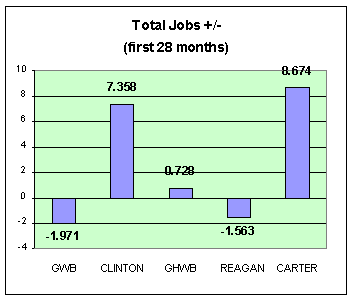 George Bush the Younger has surpassed even his idol, Ronald Reagan in the number of jobs he's seen melt away under his watch. Reagan, however, managed to turn that deficit around to a rather wimpy 2.8 million increase by November 1984, namely by pumping billions into defense spending (and running the federal deficit into the ground at the same time.) Bush the Elder, while seeing a few more months of job loss or sluggish growth, was able to come out with 1.6 new jobs by November 1992, not enough to guarantee him another term. Both Clinton and Carter's economies were job making machines. Unfortunately for Carter, other unforeseen events, namely his mishandling of the Iranian hostage situation, sabotaged his positive job growth numbers. People only seem to care about jobs when they don't have them. Gore faced similar voter complacency in his bid for the Presidency in 2000.
The question for Bush is whether he can overcome the deficit, either with real jobs or personal charm. By this point in Reagan's tenure, the economy had stopped hemorrhaging, and was quickly adding jobs. For Bush Junior, the bleeding has barely slowed, with 48,000 jobs lost in April. Will the Bush tax cut be the Band-Aid W. claims it to be? And will Democrats ever get the credit for being the party of growth and fiscal responsibility that they obviously are? History alone will tell.
posted by MB
|
link |
5:55 AM |
Friday, May 16
Flashback Friday once more
Things were relatively low key this week in 1991 - the Queen was in town, and took up much of the print.
THE RECESSION THEY IGNORED
David S. Broder, Washington Post
May 15, 1991
It has taken an uncommonly long time for official Washington to wake up to the fact that the American economy is in rotten shape. But finally that uncomfortable truth is beginning to dawn even on this city
The AFL-CIO has been tapping on the shoulders of its Democratic friends in Congress for months, telling them that unemployment is continuing to rise and more and more people each month are exhausting their jobless benefits.
Now big business is tugging on the coattails of its pals in the... UNEMPLOYMENT BENEFITS OUT OF SYNC
Hobart Rowen, Washington Post
May 16, 1991
If you lose your job, you're entitled to get unemployment insurance, right? Wrong. The nation's vaunted unemployment insurance system, crucial as an "automatic stabilizer" for the economy since the Great Depression, has lost its punch. The general public -- and that includes most members of Congress -- is unaware that today many unemployed persons get no benefits at all.
For those who do, the payments are less generous than in the past, are taxed at both federal and state... FUEL ECONOMY MEASURE SEEMS TO WIN BY LOSING
ARCTIC DRILLING PROSPECTS ALSO SAID TO WANE
Thomas W. Lippman, Washington Post Staff Writer
May 16, 1991
The Senate Energy Committee yesterday rejected competing versions of a measure to force auto makers to improve the fuel economy of their vehicles. But the proposal remains alive, and its chances may have been enhanced by the complicated maneuvering on energy policy.
Delighted lobbyists for environmental organizations said yesterday's votes also diminish the prospects for legislation to permit oil drilling in Alaska's Arctic National Wildlife Refuge. And, according to some senators... COST OF CARE LEAVES MANY IN US SEEKING BETTER WAY
Richard A. Knox, Boston Globe
May 14, 1991
Plumber Charlie McParland has a gripe millions of Americans can appreciate. Every time his union negotiates an hourly raise, most of it disappears into his health insurance.
In desperation, his union, Plumbers Local No. 12 in Boston, recently dropped its Cadillac coverage through Blue Cross-Blue Shield in favor of a Chevrolet health plan that specifies what doctors and hospitals members must use if they want full payment of their medical bills.
Based on the trajectory of the previous... BUSH ACCUSED OF USING RACIAL DIVISIONS
GEPHARDT CITES REMARKS ABOUT U.S.-MEXICO FREE TRADE OPPONENTS
John E. Yang, Washington Post
May 14, 1991
House Majority Leader Richard A. Gephardt (D-Mo.) accused President Bush yesterday of seeking political advantage from racial divisions, citing his blocking of a job discrimination bill and his suggestion that prejudice motivated opponents of a U.S.-Mexican free trade agreement
"As we enter the 1992 campaign, the president who preaches racial harmony is practicing racial division," Gephardt said in a speech on the House floor.
In a commencement speech at Hampton University in...
HIGH COURT ALLOWS 48-HOUR CUSTODY WITHOUT CHARGES
Ethan Bronner, Boston Globe
May 14, 1991
WASHINGTON -- The Supreme Court ruled yesterday that suspects arrested without a warrant may generally be kept in custody for up to 48 hours before a court hearing is held on the arrest's validity.
In a 5-4 decision by the court's conservative majority that could affect tens of thousands of arrests every year, Justice Sandra Day O'Connor said the goal was to strike a balance between the rights of individuals to prompt justice and the rights of states to set up their law... BUSH TO OFFER PLAN URGING STATE REFORM OF MALPRACTICE INSURANCE
Spencer Rich, Washington Post
May 14, 1991
President Bush will send Congress a plan Wednesday to induce state reform of medical malpractice insurance, Vice President Quayle revealed yesterday at a Chicago high school.
The plan is aimed at cutting the use of "defensive" or unnecessary medical practices and preventing doctors from refusing to perform high-risk procedures, administration officials said.
Quayle visited De La Salle High School and two health clinics with Health and Human Services Secretary Louis W. Sullivan... MIDEAST FOES LIKE PEACE BUT NOT PRICE:
BAKER FINDS DIPLOMACY:
ISRAEL AND SYRIA APPEAR TO BE THROWING UP ROADBLOCKS TO AVOID A CONFERENCE NEITHER ONE REALLY WANTS.
Norman Kempster, Los Angeles Times
May 17, 1991
The overall picture is not really changed by the minor procedural concessions that Israel agreed to make earlier in the day Thursday. There is a growing suspicion that both Israel and Syria are using the now well-known roadblock issues as excuses to avoid a conference that neither side really wants to attend. The Israeli concessions do not bring the matter much closer ... CHENEY ORDERS SILENCE ON BASE CLOSINGS
Jack Anderson and Dale Van Atta, Washington Post
May 14, 1991
Defense Secretary Richard B. Cheney wants to make sure that everyone in the Pentagon bureaucracy follows the party line on one of the most divisive issues that will come down the pike this year -- the closing of dozens of U.S. military bases to save money
The base-closing process will be a gloomy one that will hurt many states economically, put thousands of people out of work and prompt members of Congress to utter their favorite whine: "Not in my backyard, you... SURVEY SAYS 80,000 CHILDREN IN STATE HUNGRY LOW INCOMES, INADEQUATE FUNDING OF FOOD PROGRAMS CITED AS CAUSES
Gloria Negri, Boston Globe
May 17, 1991
Nearly 200,000 children under 12 in Massachusetts are affected by hunger, with 80,000 of them described as hungry while 115,000 are at risk of being hungry, according to a survey released yesterday by the Massachusetts Community Childhood Hunger Project.
The statewide study, announced during a news conference at the Westin Hotel, shows that hunger in the commonwealth is more widespread than previously believed and that it affects large numbers of working families of diverse... AMA GOES ALL OUT FOR HEALTH CARE DEBATE . . .
. . . A FAR CRY FROM ITS FIGHT TO STOP MEDICARE: REPUBLICAN HITS BUSH OVER HEALTH CARE
May 16, 1991
Richard A. Knox, Boston Globe
Jaded Americans who doubt there is substance behind the rhetoric of health care reform should take note of this week's Journal of the American Medical Association, not normally considered an outlet for crusading leftists.
Not only are crusading leftists given plenty of space to detail their prescriptions for rebuilding the US health care system, but the JAMA has brought the right wing and a slew of middle-ground reformers aboard the bandwagon... KERRY SAYS GOP IS HINDERING CAMPAIGN REFORM
May 15, 1991
Michael K. Frisby, Boston Globe
WASHINGTON -- The battle over campaign finance reform opened on a biting partisan note yesterday, as a leading Democrat accused Republicans of working to prevent any major improvements in the system.
Despite pressures from the Keating Five case, in which five senators were accused of giving special treatment to a big contributor, it was uncertain yesterday whether reformers would win their battle to retain significant spending limits and public financing in the legislation. [extra credit: Name the Keating Five]
posted by MB
|
link |
8:48 AM |
More troubling economic news
Consumer Price Stall Ups Deflation Fears
Fri May 16, 2003 10:26 AM ET
By Eric Burroughs
NEW YORK (Reuters) - Consumer prices excluding energy and food eked ahead at the slowest year-over-year pace in 37 years in April, while the once robust housing market cooled during the month, according to government data that fanned fears of the danger of deflation.
The core Consumer Price Index rose at just a 1.5 percent pace for the 12 months ended in April, its slowest clip since March 1966, the Labor Department said on Friday. The core Consumer Price Index (CPI) was flat for a second straight month -- the first time since 1982 the core index hasn't risen in any two consecutive months.
The overall CPI fell 0.3 percent in April, but like the big drop in wholesale prices reported a day earlier it was driven down by a big drop in oil prices since the start of the Iraq war eased worries of supply disruptions.
The figures raised the prospect of a further slowing in core consumer prices that has investors fearing that deflation, or an extensive decline in prices across the economy, could ensnare the U.S. like it has Japan. Of additional concern, housing starts slid a surprising 6.8 percent. Building permits were up 1.2%, but that didn't balance out the decline in starts.
At least consumers are feeling better. Whether that means they'll start spending money is another matter.
posted by MB
|
link |
8:02 AM |
Thursday, May 15
Inch up another notch on the pain index
U.S. bankruptcies rise to record high
Thu May 15, 2003 11:00 AM ET
WASHINGTON, May 15 (Reuters) - U.S. bankruptcy filings rose to a record high in the 12-month period ending March 31, U.S. court officials said on Thursday, as the weak economy hurt personal finances.
Bankruptcies rose to 1.61 million from 1.5 million in the 12-month period ended March 2002, the Administrative Office for the U.S. Courts said in a release.
The number of bankruptcies in the first quarter rose to 412,968, up 4.5 percent from the previous quarter, the court office said.
"The number of filings continues to break records," it added.
The quarterly figure is the highest in the last nine years. A spokeswoman for the courts said she believes the number is the highest since the courts have been collecting the data.
Personal filings rose while business filings fell.
Business filings were down 5.8 percent in the 12-month period to 37,548. But nonbusiness filings, the vast majority of bankruptcies, rose 7.4 percent to 1.57 million. Home mortgage foreclosures are also at a record high of 1.07%. Add in 1.4 million jobs lost, an unemployment rate of 6%, and a contracting manufacturing and tech sector, and more and more traditional conservative voters, e.g., white, middle-class and male, may soon become part and parcel of any, or even all, of these statistics. Bush might want to actually spend a bit more time and energy securing that part of his base.
[note: Last year, the House and Senate both approved legislation to tighten personal bankruptcy laws, but the compromise bill died in November's lame duck session. The House revived the bill in March, but faces an uphill battle in the Senate, with legislators not wanting to appear heartless during an economic downturn and facing an upcoming election.]
posted by MB
|
link |
9:26 AM |
More on increasing autism rates
Yesterday, I posted a chart from the follow-up report on autism to the California Legislature which indicated that over 1/3 of all autism cases were in children born between 1992 and 1998. Before I shared my own ideas regarding the surge in cases, I asked for readers opinions. I also found that Ross over at the Bloviator was posting on the subject, and furthermore seeking information on vaccine schedules.
Well, at this point, in comments on my earlier post, Natasha's suggestion comes closest to my own. Here, though, to add more fuel to the discussion, are the immunization schedules for 1989 and 1994, put out by the CDC:
1989 CDC Immunization Schedule
2 months: DTP #1 & polio #1 (25ug mercury)
4 months: DTP #2 & polio #2 (25ug mercury)
6 months: DTP #3 (25ug mercury)
15 months: MMR, DTP #4 & polio #3 (25ug mercury)
18 months: HIB (25ug mercury)
1994 CDC Immunization Schedule
Birth: HepB #1 (12.5ug mercury)
2 months: HIB #1, DTP #1 & polio #1 (50ug mercury)
4 months: HepB #2, HIB #2, DTP #2 & polio #2 (72.5ug mercury)
6 months: HepB #3, HIB #3, DTP #3 & polio #3 (72.5ug mercury)
12-15 months: MMR, HIB #4 & DTP #4 (50ug mercury)
[source for mercury level: vaccinesafety.edu]
In 1989, by six months of age, children received 75ug of mercury. By 1994, the cumulative mercury load by 6 months had increased to 217.5 ug. In 1999-2000, the American Pediatric Association recommended mercury, in the form of the vaccine preservative thimerosal, be removed from all childhood vaccines. By 2001, manufacturers complied.
posted by MB
|
link |
8:41 AM |
Forget Bush I deja vu, we're now in a Reagan time warp...
At least according to Reuter's:
Industrial Production Fell 0.5 Percent
Thu May 15, 2003 09:16 AM ET
WASHINGTON (Reuters) - U.S. industrial production fell for a second straight month in April, according to a Federal Reserve report released on Thursday, as American factories operated at their slowest pace since Ronald Reagan was in the White House.
The Fed said output at the nation's manufacturing plants, mines and utilities slid by 0.5 percent, the same as in March. Capacity utilization fell to 74.4 percent from 74.8 percent.
U.S. factories ran at an even slower pace, only 72.5 percent of capacity, the lowest reading since May 1983, when it was also 72.5 percent. Even during the Bush I recession of 1990-91, capacity never fell below 78%.
posted by MB
|
link |
6:58 AM |
New jobless claims down for second week
In the week ending May 10, the advance figure for seasonally adjusted initial claims was 417,000, a decrease of 13,000 from the previous week's revised figure of 430,000. The 4-week moving average was 439,750, a decrease of 7,500 from the previous week's revised average of 447,250.
[source: doleta.com Of course, expect that number to be revised upwards next week, as all initial reports have in the past month, by as much as 7K new claims. But all in all, it's better to see the number decrease than increase. Unfortunately, with the ax falling due to state budget red ink, I expect the number to rebound by midsummer.
The DOL doesn't have the entire press release up yet, so I'll update this on continued claims later this morning.
[update: I was able to glean the additional claim information from an AP story on the record drop in the Producer Price Index:
The number of workers continuing to collect unemployment benefits shot up by 120,000 to 3.77 million for the week ending May 3, the most recent period for which that information is available. That marked the highest level since Nov. 17, 2001, and suggested that not a lot of hiring is going on. Additional factoid: I just looked it up, and prior to the two-month surge in continued claims cause by the 9/11 attacks, the last time claims rose above 3.5 million was the first week of June, 1991. Ironically, new claims then were also down for the third straight week. While analysts at the time asserted this indicated that the sluggish US economy was turning the corner after the conclusion of the Gulf War, it turned out merely to be a reprieve; by fall, unemployment was on its way back up, and the ecomomy back in the doldrums.
posted by MB
|
link |
5:47 AM |
Wednesday, May 14
A hint of a spine from Senate Dems?
A vertabra or two is all we ask. Tell us this is just the beginning:
Congress raised the debt limit by $450 billion last year, and Democrats made it clear today that they intended to use every future request for an increase to criticize the administration's economic policies. They unveiled a new "debt clock" today that measures the size of the national debt, and announced they were opening an "economic recovery room" off the Senate chamber where Democratic senators could go to denounce the White House.
Senator Frank R. Lautenberg, Democrat of New Jersey, unveiled a mock credit card with President Bush's picture on it, drawn on "The Bank of Our Children's Future," which was stamped as over its credit limit. I like to find a Java-based version of the debt clock to run on Wampum and/or ISTE. If anyone knows of one, email or add to comments please.
posted by MB
|
link |
8:11 AM |
Ouch
After the War, shoppers are sure to come out in droves, right? Wrong.
Retail Sales Ease Unexpectedly in April
Wed May 14, 2003 08:30 AM ET
WASHINGTON (Reuters) - U.S. retail sales fell unexpectedly in April with sales excluding autos posting their biggest drop since September 2001, the government said on Wednesday, raising questions about eagerness of American consumers to shop.
Some of the slip stemmed from a fall in gasoline prices, which depressed the dollar value of the amount of goods Americans purchased, and the Iraq war may have added to consumer uncertainty. The latest report from the Commerce Department showed soggy demand at clothing stores, furniture shops and other retail outlets, although strong car sales helped to offset some of that weakness.
Total retail purchases slid 0.1 percent in April in contrast to the predictions of U.S. economists in a Reuters survey who expected sales to rise by 0.4 percent. In the closely watched category of sales excluding automobiles, purchases slumped 0.9 percent, the biggest drop since a 1.2 percent fall when the Sept. 11 attacks dealt a sudden and harsh blow to retail sales.
However, stripping out gasoline, total retail sales rose by 0.4 percent. While that may sound like good news, March's retail sales were up 2.3%, leading some economists, including Alan Greenspan to think perhaps the worst was over. Apparently not.
I did mention that this happened just after Gulf War I as well. Those who do not learn from history are doomed to what again? Repeat it? And I don't suspect things may get much better in the immediate future. The latest ABC News/Money magazine Consumer Comfort Index (via Polling Report) indicates consumer sentiment dropped sharply in the past four weeks, down 9 points since mid-April.
Time for Bush to start pushing his $726,000,000,000 tax cut even harder. Got to get the money into the hands of the super-rich so they can start buying Fords and Chevys.
posted by MB
|
link |
6:48 AM |
More on the new California Autism report
The entire report, entitled Autistic Spectrum Disorders: Changes In The California Caseload An Update: 1999 Through 2002 is now available online in .pdf format. There's a lot in the report to discuss, which I probably will do over the next few days.
One visual in particular, however, struck me to the extent that I felt compelled to share it as soon as possible.
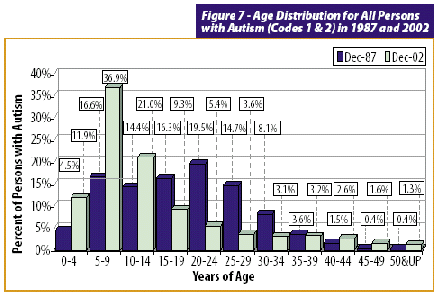
According to this graph, over a third (37%) of currently diagnosed cases of autism have been in children born between 1992 and 1998. That is more than in the preceding three birth cohorts from 1978 to 1992 combined, although it appears as though whatever trend led to the skyrocketing of autism during the 1990s may have begun sometime during the preceding birth cohort years between 1987 and 1992. Since autism is generally not diagnosed until between ages two to four, the trend may also have spilled over into in the youngest group, born after 1998.
When I look at this chart, it's obvious that some trigger or triggers entered the picture sometime after the late 1980's. This is not a relic of diagnostic changes or shuffling kids from column A to column B; that was the job of the first UC-Davis study to sort out.
Before I share my own thoughts, I'll take my reader's hypotheses first.
posted by MB
|
link |
5:11 AM |
Texas Republicans play dirty with the Bees
What's the old saying? When you can't beat 'em....intimidate their families?
The state officers who are in charge of rounding up the runaway lawmakers, meanwhile, were accused Tuesday by some Democrats and their relatives of heavy-handed tactics .
"Once our wives tell them they don't know where we are, that should be the end of it and once they know where we are that should be the end of it," said Craig Eiland of Galveston, one of 51 Democrats holed up in an Ardmore, Okla., motel. Eiland accused state House Speaker Tom Craddick of using Texas Department of Public Safety officers to intimidate their families and staffs, even after the legislator's location in Oklahoma was disclosed on Monday. Such harassment included:
* A Texas Ranger, instructed by the Craddick, appeared late Monday night at the University of Texas Medical Branch-Galveston NICU, where Eiland's premature twins are patients. The same Ranger even later that night went to Eiland's home to question his wife, still recovering from the twin's birth.
* A state trooper told a senior staffer of Elliott Naishtat (D-Austin) that withholding information regarding the missing legislator was a felony offense, even though State House rules governing quorums carry no civil or criminal sanctions.
* The wife of Democrat Chuck Hopson (D-Jacksonville) was tailed by Rangers from Austin to Jacksonville on Monday.
* Denise Pickett, the wife of Joe Pickett (D-El Paso) returned home Monday night after receiving a phone call from her teenage daughter, saying that police were at the house. When she arrived home, she found the officers emerging from the from the house, having questioned her minor child without her presence or consent.
The Texas DPS spokeswoman Teela Mange said "she could not explain why family members were questioned if authorities knew where the legislators were."
Having had a child in a NICU after birth, I cannot imagine any explanation other than sheer intimidation that a uniformed officer would interrogate hospital staff engaged in carrying for sick infants. Such behavior is just beyond the pale and if Craddick ordered it, knowing full well the location of the twins parent, he should be held accountable.
Republicans in Texas may not like the tactics the Democrats are employing, and they have all he reasons in the book to vent their frustrations civilly - they are "civil" servants after all, and represent all of their constituents, regardless of political affiliation. But some Republican actions, such as Craddick's attempts at intimidation and the House Republican's printing of playing cards similar to those used to catch wanted Iraqi officials, only rubber stamps more thuggery from non-legislators. Already, wanted "dead-or-alive" posters are popping up on right-wing websites. How long before someone decides to take those signs seriously?
posted by MB
|
link |
4:02 AM |
Tuesday, May 13
The rose tinting in those glasses is beginning to fade
Ever so slightly.
First, there's the realization you've been duped. As long as there's no real harm done, the critique remains on simmer. But there are now cracks in the foundation; how long before they become deep fissures?
Poll finds about half of Americans believe Bush overestimated Iraqi weapons
Tuesday, May 13, 2003
Associated Press
About half the country believes the Bush administration overestimated the number of weapons of mass destruction in Iraq, according to a poll released Tuesday, but most people feel the war was worth it anyway.
The CBS News-New York Times poll found 64 percent of Americans are aware that no weapons of mass destruction have yet been found in Iraq.
Some 49 percent said the administration overestimated the amount of mass destruction weapons in Iraq, while 29 percent said its estimates were accurate and 12 percent said they were low.
Two-thirds of those who believe the weapons count was overestimated also believe it was a deliberate exaggeration to build support for the war.
Still, 56 percent said the war will have been worth it if weapons of mass destruction are never found, while 38 percent said it would not have been worth it.
Similarly, 56 percent said the war would have been worth it even if Saddam Hussein is never captured or killed, while 37 percent say it would not have been worth it.
Asked who should take the lead in setting up a new Iraqi government, 45 percent preferred the United Nations; 34 percent say the United States should manage things entirely on its own for now; and 13 percent want the United States to lead but also want a U.N. role. Although AP seems to want to spin this next result for Bush, it's actually not much better than where he was before he started his tax-relief-for-rich-friends tour.
A question about the new round of tax cuts suggested good news for the Bush administration: 41 percent of respondents think the cuts would help rather than hurt the economy; 19 percent think they would be bad for the economy; and 33 percent think they would have no effect. Hmmm...so 52% of Americans think spending $726,000,000,000 will do nothing for the flailing economy? Sounds like great news for Bush.
posted by MB
|
link |
7:39 PM |
New autism report out from California
And it's not at all good. Not unexpected, at least for those of us who have suspected that autism is in fact reaching "epidemic" proportions, but bad news nonetheless.
Report: Calif. autism rate has doubled in four years
Beth Fouhy
Associated Press
May 13, 2003
SAN FRANCISCO - The number of children with autism in California has nearly doubled in the last four years and continues to grow as researchers struggle to identify the cause of the incurable developmental disorder, a new report released Tuesday found.
The report by the California Department of Developmental Services found that 20,377 California children were receiving DDS services for autism as of December 2002 - a 97 percent increase since 1998. The disorder is now more prevalent in California than childhood cancer, diabetes and Down syndrome. [my emphasis, explained below.]
Autism - a lifelong neurological condition found mostly among males - severely impairs a person's ability to speak, communicate and interact with others. The report addresses only those with "classic" autism, the disorder's most severe form characterized by severely limited speech, impaired social interaction, and repetitive behaviors such as finger tapping. Children under three years of age, and those with lesser forms of the disorder such as Asperger's syndrome, were not included.
The report is the continuation of a study published by DDS in 1999, which showed a 237 percent spike in autism cases from 1987 to 1998.
Ron Huff, a psychologist who conducted both studies for DDS, said the latest numbers reflect an actual increase in autism in the state, not just improved diagnosis of existing cases.
"After we did the first report, we anticipated the numbers would go down," Huff said. "Instead, they were actually increasing. It's not just a matter of better diagnosis." [more of my own emphasis]
Indeed, despite a broader awareness of autism and stepped up research in recent years, the DDS report said scientists have not yet pinpointed a cause for the disorder. A once-dominant theory, now discounted, that placed blame on cold and distant mothers for causing autism has given way to a more thorough investigation of the potential genetic and environmental factors that may increase a child's vulnerability to the condition.
"We know that it's a very complicated genetic disorder, but it's also probably true that genes are not the entire answer," said Dr. David Amaral, research director for the MIND Institute at University of California, Davis, which studies autism. "It's most likely a combination of genetic susceptibility and an environmental disorder."
DDS researchers are looking at range of environmental toxins that could make children more vulnerable, including PCBs, pesticides, and heavy metals such as mercury and lead. They are also exploring the debated theory that childhood vaccines may be at the root of the problem. The earlier MIND Institute study did find that a portion (<20%) of the children in California had been improperly misdiagnosed as mentally retarded, or not diagnosed at having multiple handicaps including autism. Thus the researchers thought that in this study, the increase would be significantly less, or none at all. What they found was a stunning near 97% increase in four years. In the past two years, Maine had a similar upsurge; the new December 2002 numbers were recently released, and in just two years, Maine experienced a 42% increase in cases with a single diagnosis of autism (versus autism as one of multiple disabilities.) The argument that autism was improperly classified as mental retardation continues to show its flaws. In the past two years, the number of children with MR diagnoses has decreased only 4%, a number which may in fact have a greater correlation to tightening of Maine's lead paint laws in the past 20 years.
Recently, an autism advocacy critic asserted that autism somehow gets lots of attention because it effects white, middle- and upper-class children. I pointed out that it effects poor, non-white children around the world in equal numbers, only distinguishing between males and females. But the argument just doesn't ring true when the facts are laid out. If funding for autism research is compared with that of two other major "epidemics", HIV/AIDS and diabetes, which portionally affect more non-whites than whites, it barely registers on the map. In fact, below is a graph of the funding levels by NIH for the three diseases:
 [source: House Committee on Reform]
[note: on my computer the labels are fuzzy - the first columns represent diabetes funding, the second HIV/AIDS, and the third, autism]
Since identifying HIV/AIDS as an epidemic through the end of 1998, 5,237 American children under age 13 were reported as living with the disease. Pediatric AIDS cases decreased by two-thirds from 1992 to 1997 (947 to 310 cases). Juvenile diabetes affects one child in 7,000 in the US, versus the most recent CDC estimate of 1:250 rate for autism. Yet despite affecting hundreds of thousands of children in this country, autism is largely ignored by Congressional check writers. If this is the best we can expect from white middle class parents, I think they're doing a pitiful job. [sarcasm off]
The truth is, autism isn't "sexy", at least to those footing the research bills; there is no insatiable market for insulin or AZT. A few doctors prescribe anti-depressants or sleep aids, that's about it. Big Pharma has focused most of its autism research money on saving its own hide; trying to disprove a link between vaccines and autistic disorders is the black hole for drug company cash.
Even with this phenomenal increase in cases of autism, POAs shouldn't expect much relief from the Federal government. The 20 billion Congress might give the states would barely pay for standard services for California's autistic population for 2 years (20K kids at about 50K/year each.) Oh, that's if there's no further increase. And while most of the non-autistic advocating population thinks, hey, it doesn't affect me, think again. Disabled kids get first dibs on school funds; they have a Constitutionally guaranteed right to a "free and appropriate public education". School districts will have to cut everything but math and English before they stop providing even the most expensive services to special needs kids. Parents of non-disabled kids used to complain that their kids didn't get soccer uniforms because of the cost of special education. Ha! With the radical Republicans in charge, that's just the tip of the budget-cutting iceberg, I'm sorry to say.
posted by MB
|
link |
5:22 PM |
The other Powell sits poised to strike
And his target is not Iraq, but your access to information.
F.C.C. Prepares to Loosen Rules on Media Ownership
By STEPHEN LABATON
WASHINGTON, May 12 — The government proposed the most significant overhaul of its media ownership rules in a generation today, including a change that would allow television networks to own enough local stations to reach 90 percent of the nation's viewers.
That change — a result of increasing the cap on ownership and simultaneously preserving a 1980's formula that discounts the reach of UHF stations — is part of the package of proposals that officials said appeared to have the support of the Republican majority of the Federal Communications Commission.
The commission staff sent the detailed plan early this evening to the five commissioners ahead of a final vote in three weeks. The commission has not formally made the plan public, though major portions were disclosed today and in previous days by officials and industry experts.
The proposed changes represent the most important rewriting of the ownership rules in decades, permitting the largest media conglomerates to expand into new markets and own more properties in a single city. Analysts expect companies, including Viacom and the News Corporation, to seek to expand their media holdings substantially.
Others, like the Tribune Company and the Gannett Company, might seek to acquire broadcasters or newspapers in cities where they already have a presence. Media brokers and Wall Street bankers have begun advising clients on what is expected to be a scramble of mergers that would reshape the media landscape in many communities across the country.
In a recent interview and in other comments, the agency's chairman, Michael K. Powell, said that revisions in the media ownership rules would be more modest than critics had maintained and that changes in technology and viewing habits, combined with court decisions and a Congressional directive, necessitated that the current regulations be reconsidered.
But the agency's two Democrats have expressed concerns about many aspects of the proposal. In interviews today before receiving the detailed plan, the two commissioners, Michael J. Copps and Jonathan S. Adelstein, said that they were troubled by reports that the commission's staff, after extensive consultations with Mr. Powell, would recommend raising the ownership cap while retaining the formula that discounts the audience size of UHF stations.
"I'm afraid we may be moving in a more dramatic fashion that could permanently alter the media for generations to come," Mr. Adelstein said.
Mr. Copps said that the changes, including the sharp increase in the television ownership cap, "would be a green light to considerable and significant consolidation in the future."
"It's hard to imagine how the proposals foster the goals of the rules, which are diversity of voices, localism and competition," he said. Lisa English, of Ruminate This, has been a pitbull on this issue. And now, she got the Lefty Blogosphere on the case.
I can't even imagine what media consolidation would do to the Maine market, already on its proverbial deathbed. Our local paper is owned by the parent company of the Seattle Times, we have only 3 local broadcast stations for the state, plus much of north and eastern New Hampshire.
So head on over to Ruminate This and get your activism on.
posted by MB
|
link |
11:45 AM |
Fax the Bees!
Okay, so they're actually now being called the Killer "Ds", but I'm still wedded to the old '79 name. But if you'd like to show your support for the Bees or the Ds, here's the contact info for the hotel where at least 50 of the swarm have congregated:
The Ardmore Holiday Inn's telephone number is (580) 223-7130. They receive faxes on the same line as voice.
Send a fax expressing your support to:
THE TEXAS DEMOCRATS
Ardmore Holiday Inn
Ardmore, OK
And if you're within 200 miles of Ardmore, what are you doing reading this? You should be in your car, on your way to rally in person for those brave Dems.
posted by MB
|
link |
11:16 AM |
The Killer Bees migrate north
Missing Lawmakers Turn Up In Oklahoma
Lawmakers Say They Plan To Resume Work Sessions Tuesday
Updated: 8:30 a.m. EDT May 13, 2003
ARDMORE, Okla. -- They wore jeans and baseball caps, but Texas House Democrats say their day in Oklahoma wasn't fun and games as they skipped the state legislative session and brought the House to a standstill.
About 59 Democrat lawmakers spent Monday in a Holiday Inn conference room in Ardmore, along Interstate 35 about 30 miles north of Gainesville, Texas. They said they discussed school financing, homeowners insurance and other issues and planned to resume the work sessions and hold a news conference Tuesday explaining Monday's actions.
The rebel lawmakers, discovered Monday night, said they didn't show up for work because they're angry with the Republican leadership in the Texas House.
The boycott occurred just before debate in the House on a congressional redistricting plan was scheduled to begin.
GOP leader Tom Craddick sent state troopers to ask them to return, but the Democrats refused.
The troopers have no legal authority to arrest the lawmakers, but Craddick said he made a plane available to Democrats who chose to go back so that the House can continue state business. Yesterday, in comments, Steve Bates explained the renegade lawmakers' position in greater detail than the news accounts:
Democrats in the Texas Legislature are attempting to stop the second gerrymander in as many years... this one of congressional districts, including mine... by Republicans.
The previous gerrymander map, the State Legislature map, was redrawn by John Cornyn, then state attorney general, now U.S. Senator. The attempted redraw of the congressional map is being perpetrated by... you should have guessed it... Tom DeLay, using the results of the first gerrymander as expressed in the 2002 election. If it succeeds, the GOP will gain 5 to 7 seats in the U.S. House... with no voters' minds being changed. Kos, over at the Daily Kos, is also following this story. He provide more on attempts by Texas governor Rick Perry to have the feds get involved so they can arrest the legislators in Oklahoma.
It's so heartening to see Democrats act like Democrats, and in Texas no less. Go Bees, Go!
[Update: Kevin Drum has a map of one proposed district - all 300 miles of it)
posted by MB
|
link |
6:07 AM |
Monday, May 12
Return of the Killer Bees
Sounds like a bad B-movie...(yes, there's a pun there.)
However, Congressional Democrats should head to Texas this week to get a lesson in playing hardball. Thing is, there may not be many Texas Democrats to teach them.
But that is exactly the point.
Report: House Democrats plan to break quorum
Associated Press
Monday, May 12, 2003
SAN ANTONIO — A group of Texas state representatives reportedly plans to leave the state with the intent of breaking a legislative quorum.
One of the organizers told the San Antonio Express-News in Monday's editions that the action was planned this week as retaliation against the state's Republican leadership.
The plan by Democratic House members, if successful, would derail and likely kill major pending bills that have been termed a priority by the Republican-controlled Legislature.
"We're leaving, and we'll stay gone till Thursday," one member from South Texas, who spoke on condition of anonymity, told the newspaper.
Sources said the group's members were leaving Sunday night and planned to issue a prepared statement Monday morning to explain its actions.
Several of the legislators who planned to be absent said they were expecting the worst.
"I guess we will be called obstructionists, or maybe worse. But we are making a statement," said the South Texas legislator. "If this is going to be the only way to stop bad legislation from being rammed down our throats, then so be it."
Legislative leaders have three weeks left in the regular session and major pieces of legislation still pending. The breaking of a quorum hasn't been used in more than 20 years as a parliamentary maneuver, officials said.
Such a move would require at least 51 members to be absent from Monday's session, scheduled to convene at 9 a.m., for House activity to be brought to a halt. The Texas House cannot convene without at least two-thirds of the membership, or 100 members, present on the House floor under legislative rules.
Republicans, in major legislative battles thus far, have used their majority among state representatives to aggressively push major legislation, such as the reorganization of state government, House Bill 2, and the school finance bill, House Bill 5. Those and other Republican-promoted measures must pass out of the House and be sent to the Senate by Thursday or risk dying.
Twenty-four years ago this month, a group of 12 Texas state senators defied then-Lt. Gov. Bill Hobby by refusing to show up at the Capitol. The "Killer Bees," as the 12 came to be known, hid out in a West Austin garage apartment while Department of Public Safety troopers, Texas Rangers and legislative sergeants-at-arms unsuccessfully combed the state for them.
The latest group of quorum-busters planned to leave the state to avoid having state police detain them and forcibly return them to the House floor, if necessary.
"DPS or the Rangers can't exactly come get us if we are outside of Texas," said another legislator. One hopes that the legislators who are choosing this tactic are in safe Democratic districts, and have constituents who will appreciate having these men and women risk their political futures to stop harmful legislation.
If killer bees can invade Bush Country, maybe they'll begin migrating north.
posted by MB
|
link |
8:23 AM |
And the Red states get bluer over increasing unemployment
Over the weekend on the Daily Kos, RonK, filling in for Kos, took a look at the strengths and weaknesses of the 2004 Senate races, and other related state politics concerns for Democrats. Within comments, I pointed to the graph I drew last month, looking at how specific state unemployment levels could conceivably impact a close Presidential election.
I received an update via email from the BLS last week, but didn't have time to run new numbers. My sense, though, was that unemployment numbers had increased in nearly all the battleground states.
I was correct. Only in Pennsylvania and West Virginia did the local unemployment rate decrease. Last month, only two states had seen an increase of 2.0% or more; this month, the number increased to seven.
State
| R/B
| Electoral Votes
| Margin
(Bush vs Gore+Nader)
| 2001-03 Change in
Unemployment Rate
| Colorado
| R
| 8
| 4
| 3.2
| Oregon
| B
| 7
| -5
| 3.2
| Michigan
| B
| 18
| -7
| 2.2
| Virginia
| R
| 13
| 7
| 2.1
| Ohio
| R
| 21
| 1
| 2.0
| Arizona
| R
| 8
| 3
| 2.0
| New Hampshire
| R
| 4
| -3
| 2.0
| Wisconsin
| B
| 11
| -4
| 1.7
| Pennsylvania
| B
| 23
| -7
| 1.5
| Iowa
| B
| 8
| -3
| 1.5
| Florida
| R
| 25
| -2
| 1.5
| Minnesota
| B
| 10
| -7
| 1.3
| Nevada
| R
| 4
| 2
| 1.3
| Missouri
| R
| 11
| 1
| 1.2
| Arkansas
| R
| 6
| 4
| 0.7
| New Mexico
| B
| 5
| -4
| 0.7
| Tennessee
| R
| 11
| 3
| 0.6
| Louisiana
| R
| 9
| 7
| 0.6
| West Virginia
| R
| 5
| 4
| 0.2
|
Ron mentioned he'd like to see the numbers for the "hard" Red states. Always willing to crunch more unemployment numbers, here they are:
State
| R/B
| Electoral Votes
| Margin
(Bush vs Gore+Nader)
| 2001-03 Change in
Unemployment Rate
| Texas
| R
| 32
| 19
| 2.9
| Oklahoma
| R
| 8
| 22
| 2.5
| South Carolina
| R
| 8
| 15
| 2.5
| Utah
| R
| 5
| 36
| 2.3
| North Carolina
| R
| 14
| 13
| 1.8
| Kentucky
| R
| 8
| 13
| 1.6
| Indiana
| R
| 12
| 15
| 1.5
| North Dakota
| R
| 3
| 25
| 1.4
| Mississippi
| R
| 7
| 16
| 1.4
| South Dakota
| R
| 3
| 22
| 1.4
| Kansas
| R
| 6
| 18
| 1.1
| Georgia
| R
| 13
| 11
| 1.1
| Idaho
| R
| 4
| 40
| 1.0
| Wyoming
| R
| 3
| 41
| 0.8
| Alabama
| R
| 9
| 13
| 0.8
| Alaska
| R
| 3
| 21
| 0.7
| Montana
| R
| 3
| 19
| -0.3
|
Looks like Bush has some explaining to do back in his home state.
[x-posted at ISTES]
posted by MB
|
link |
5:01 AM |
Saturday, May 10
Light blogging ahead (at least this weekend)...
Next week is Kikas, the Planting Moon. The weather here in Maine has been rather cold and wet so far this spring, so I haven't been able to do much preparation. Since today was absolutely gorgeous, I scampered off to my favorite equipment rental (no joke, they know my voice when I phone) to pick up a Pony for the weekend. Mother's Day, Schmother's Day - I've got a quarter acre to till before the full moon on Thursday.
This Kikas is even more special as it is the first lunar eclipse visible in Maine in three years. That it falls on the planting moon is particularly auspicious - I expect you'll all be bugging me to Fed-Ex you wskimenal (sweet corn) and wasawal (squash) come August.
I should be back Monday, but may blog in the wee hours if insomnia strikes. I suspect, though, I'll be sleeping like a rock after all that tilling.
If you're reading this Saturday evening or later, you've already missed the Dartmouth spring powwow. However, for those in the Bay Area, the Stanford Powwow continues through tomorrow.
posted by MB
|
link |
4:58 PM |
Friday, May 9
Mastercard quote of the day
Here are some facts on judicial nominations.
The number of Bush circuit court nominees the Senate has confirmed: 22.
The number of Bush nominees confirmed to the district courts: 101.
The number of Bush judicial nominees currently being filibustered: 2.
The claim that Democrats are being obstructionist: priceless. And laughable.
-- E.J. Dionne Jr [via The Note]
posted by MB
|
link |
11:41 AM |
The Ghost
A work of fiction?
Chapter I.
I've been haunted by a ghost named David recently. He first appeared a few days back, while I was driving alone to the grocery store. Next, he showed up while I was showering. Then, anytime I had a few minutes of down time in my hectic daily schedule, he was there. Now, he's not even that considerate; he's edging in on my activities, while I make lunches, change diapers or try to solve the puzzles of US unemployment.
David wasn't always a ghost. He was once a well known scholar with a long and promising career in academic archaeology. His work on the origins of agriculture is hailed as essential reading for all Americanists. In fact, we first met when I offered a rather blistering critique of his theoretical framework on a newsgroup frequented mostly by archaeology grad students and interested amateurs. Never did I expect the pre-eminent Dr. Rindos to answer my not-so-flattering assessment, and with such humor and graciousness. We immediately became frequent correspondents, as David had previously emigrated to Australia to take a teaching position at the University of Western Australia. We also became good friends, despite always remaining on opposite ends of the theoretical spectrum, archaeologically-speaking.
David and I were also on other electronic anthropology lists together. It was on one such list that David was brutally defamed by an Australian graduate student named Gil Hardwick. Hardwick was seething over David's bringing to light accusations of sexual misconduct with, and abuse of, graduate students by his department head. In a post to the internet anthropology list, Hardwick accused David of engaging in pedophilia, racist behavior and drunkenness. He also claimed David had no genuine academic ability in his field, in fact, was a pitiful scholar who had made his name by berating and bullying his way to the top.
David sued Hardwick, and in a landmark decision regarding accountability for ad hominem speech on the internet, was awarded $40,000 in damages for libel and defamation by Hardwick. In the meantime, David was also battling UWA, which had denied him tenure.
Between the two conflicts, the personal and professional toll on David was staggering. Hardwick played the homophobia card with his accusations of pedophilia: David was openly gay, and in conservative enclaves of Western Australia, pedophilia and homosexuality were viewed as synonymous. He was constantly harassed and threatened, and the stress was immeasurable. In December, 1996, I received an email from a mutual friend that David had suffered a fatal heart attack: He was 49.
I, like hundreds of David's friends and colleagues, could not imagine standing by while he was defamed by Hardwick. We rallied around him, pushed his case to the media and Australian government, and isolated Hardwick as a xenophobe and anti-gay bigot.
David's current haunting, I know, is an effort to remind me of that person I once was. For days, I've been shooing him away, like a pesky fly. It's not my problem, I tell the annoying apparition. Someone else will handle it. Even my friends advise me not to get involved. If I just turn my face while I walk by the alley, I won't see the homeless man being mugged.
Besides, the left side of the blogosphere recently suffered a significant blow with Sean Paul Kelley's admission of plagiarism. Although Kelley apologized and came to an amicable resolution with the victim of his misdeeds, the denunciations quickly turned from Kelly's actions to the silence within much of the blogging Left in regards to his behavior. While the criticism was on many levels valid, the whole debate was seeped in politics: The Left had denounced the great leader Bush while supporting an admitted plagiarist; ergo, the Left had no credibility. The slap still stings.
Why stir up the hive again?
Is it fear which paralyzes me? People will be angry with me. They'll boycott my blog. They'll harangue me in other blog's comments. And besides, I actually dislike confrontation. If I wait long enough, someone with more backbone than I will address the situation.
And truth be told, Ghost, I already took some action. I removed accusations I knew to be libelous and defamatory from my comments. I've suggested the victim seek legal counsel. I've now immunized myself from claims of hypocrisy from the Right. What do I gain from doing anything more?
Chapter II.
Still in progress. It's hard to reach the keyboard without a spine.
posted by MB
|
link |
8:08 AM |
|
|
|
 |
|